Picture a Gyeongju afternoon held between two kinds of curve: a tiled roof above a shop and the rounded outline of a burial mound. A suggested visit to Hwangnidan-gil and Daereungwon can move between those scales without trying to exhaust either. Give the street your curiosity, give the tombs your attention, and let a pause for something to drink sit comfortably between them.
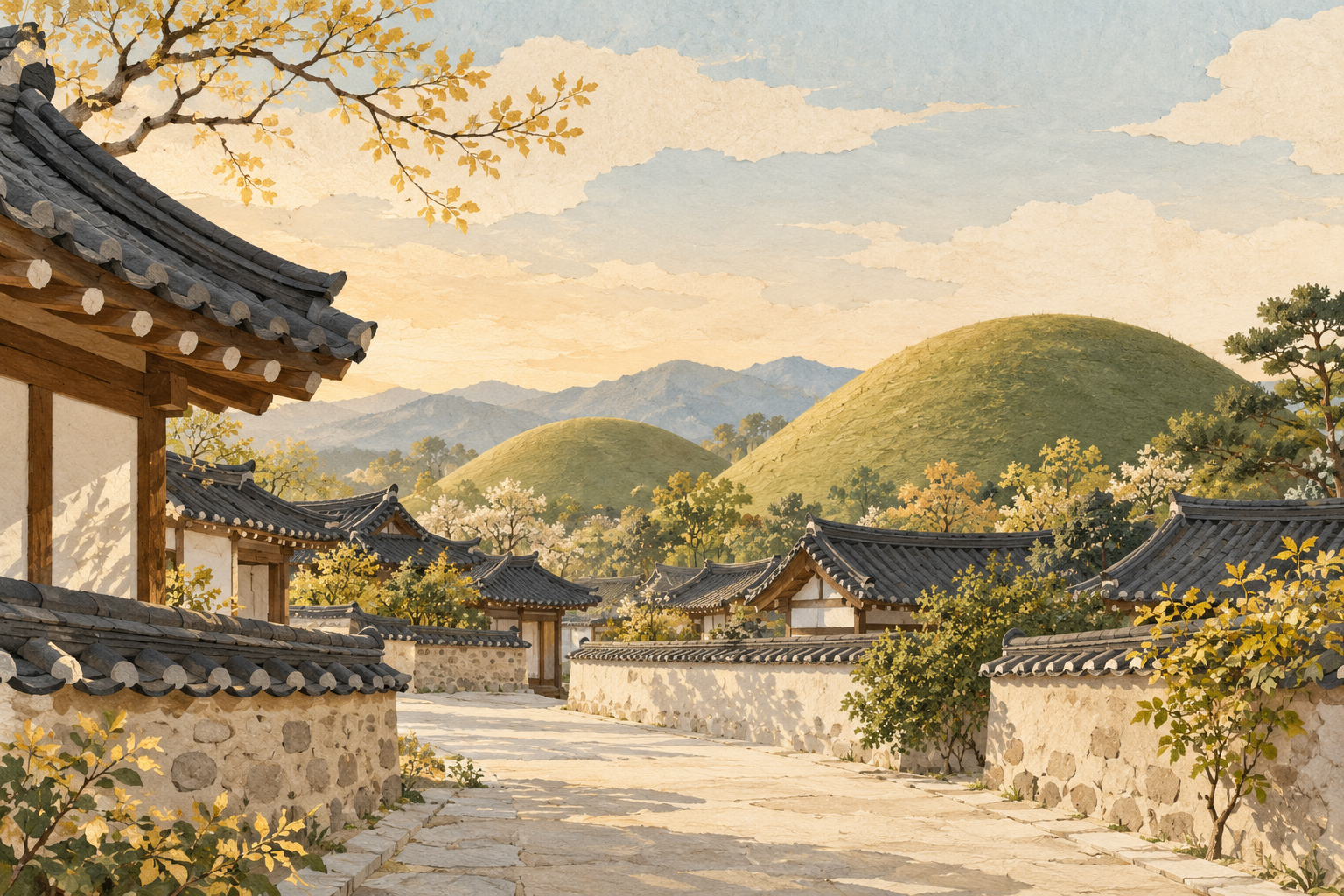
Conceptual AI-generated editorial illustration; not an on-site photograph or map of Hwangnidan-gil or Daereungwon.
The interesting thing about pairing these places is the change in what you notice. A shop window asks what appeals to you now. A tomb asks you to imagine what survives across centuries. You can carry both questions through a single afternoon.
The street has a present tense
The Korea Tourism Organization's Hwangnidan Street listing describes restaurants, cafes, shops and photo studios in hanok buildings, alongside older buildings from the 1960s and 1970s. The name joins Hwangnam-dong with Seoul's Gyeongnidan Street. That mixture is a useful introduction: this is a contemporary commercial street with several layers of architecture and identity.
Begin with a small stretch and look at how businesses present themselves within the buildings. Notice a sign in relation to a roof, or the way a doorway draws you in. If you step inside a shop, let the actual objects and prices guide your interest. You do not need to arrive with a list of purchases to make the street worthwhile.
Choose a pause by the seat and menu available to you. You might want a drink, a small meal or simply time to decide where to go next. The best stop for this proposed afternoon is the one that fits the day you are having. Individual businesses set their own hours, so leave your choice open until you see what is operating.
The mound and the horse
Move to Daereungwon when you are ready for a different kind of looking. KTO's Cheonmachong introduction describes paths among the ancient tombs, including Hwangnamdaechong, Cheonmachong and the tomb of King Michu. Follow the marked visitor route and allow each mound enough space in your attention to register as a tomb.
Cheonmachong supplies a particularly vivid object to think about. Excavated in 1973, it takes its name from a painting of a heavenly horse on a saddle flap. The object gives an extraordinary name a material beginning: a picture on something made for use. Imagine the shift from an object placed in a burial to an object studied and interpreted much later.
Should you choose the tomb interior, check its separate admission arrangements. KTO's Daereungwon listing distinguishes the free Daereungwon grounds from paid Cheonmachong entry. Your visit can work with either choice. KTO also notes that excavated objects from Cheonmachong are held at Gyeongju National Museum; plan a museum visit separately if those objects become the thread you want to follow.
A mound gives the landscape a shape; a single object gives history a place to begin.
Carry the curve back
After the tombs, return to the street only if you want to. The pairing does not require a second circuit. You might find that you look at the rooflines differently now, or that an ordinary object in a shop holds your attention for longer. These are possible pleasures of the sequence, rather than conclusions you are expected to reach.
Keep one specific detail from each place. Perhaps it will be a doorway you noticed on the street and the saddle-flap painting you read about at Cheonmachong. Write down their names before they dissolve into a general memory of an attractive town. Specificity leaves you somewhere to begin when you want to learn more after the trip.
For related reading, our Jeong-dong afternoon follows another conversation between a historic setting and present-day culture. Our Gwangjang lunch essay offers a similarly modest approach to a food stop. At Gyeongju, the invitation is to let a lively street and an ancient burial landscape share an afternoon, while giving each its own terms.
Shape your visit
- Street reference: KTO lists Hwangnidan Street at 1080 Poseok-ro, Gyeongju-si.
- Tomb reference: KTO lists Cheonmachong at 9 Gyerim-ro, Gyeongju-si. Check the entrance for the part of Daereungwon you want to visit.
- Admission: Grounds and tomb-interior entry are distinct. Recheck current arrangements before choosing your visit.
- Scale: One section of the street and a considered visit among the tombs are enough. Business hours vary by store.
Official sources checked 26 October 2026: KTO's Hwangnidan Street and Cheonmachong listings, plus its Daereungwon visitor information. The paired sequence and looking prompts are original editorial suggestions. No personal visit, tasting or particular business availability is implied.
'Visitor Guides' 카테고리의 다른 글
| The City Above the Station: Reading Choryang's Hillside (0) | 2026.10.26 |
|---|---|
| BTS Bus Stop in Jumunjin: The Album Frame and the Beach Beyond (0) | 2026.10.26 |
| BTS Places in Busan: V's Park, Jimin's Shore (0) | 2026.10.26 |
| BTS Places in Seoul: K-Star Road, HiKR and a Fan Day of Your Own (0) | 2026.10.26 |
| A Market Lunch, Without the Rush: Finding Your Rhythm at Gwangjang (0) | 2026.10.26 |