Seoul Forest can hold a different kind of city afternoon: a sculpture, a pond and a stretch of path, chosen for the pleasure of being outdoors. Come with a small plan and let the park supply its scale.
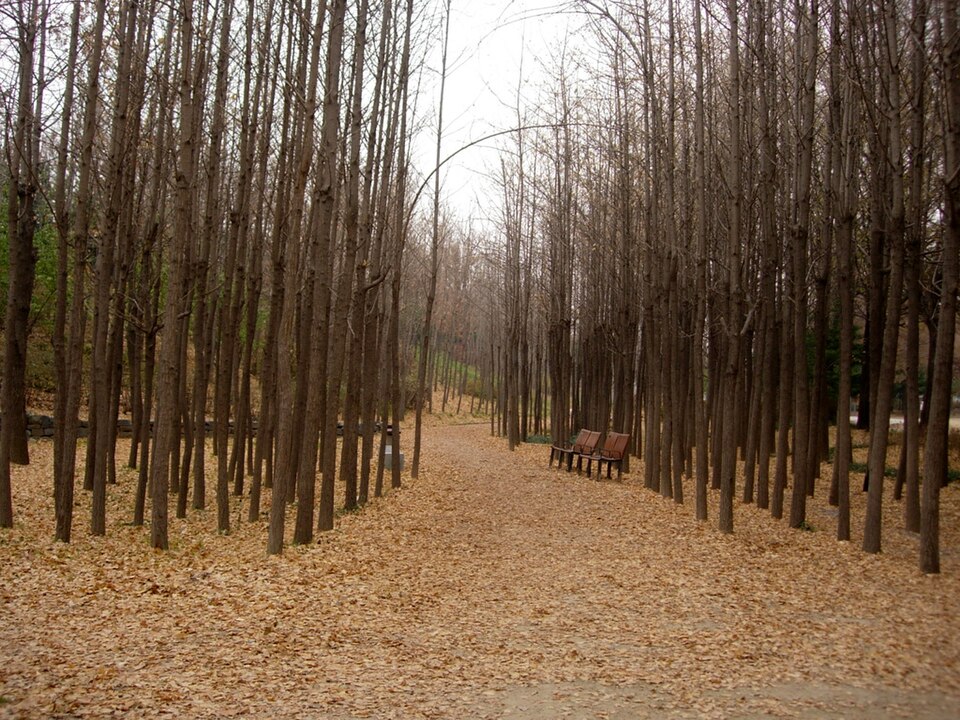
A walking road in Seoul Forest, photographed in November 2009. Photo: Enigma7seven, “Seoulforest 001.jpg”, CC BY-SA 3.0, via Wikimedia Commons. Resized for display.

The running horses are an energetic beginning for a visit that can be taken slowly. Seoul's park guide identifies the horse sculpture at Seoul Forest as START, a reminder that this ground once served as a racecourse. It gives you something concrete to look at before the paths ask you to choose a direction.
A good park visit can begin with that small change of attention. You arrive with appointments, purchases or photographs in mind, then find an object worth stopping beside. Keep the next decision equally modest. A pond and a place to pause can be enough to give the afternoon a shape.
A public park with previous lives
Seoul Forest opened in 2005. Its current city guide lists areas for culture and art, ecology and nature learning. That range helps explain why a visit can take several forms without requiring you to sample them all.
The horses make a useful first subject because a sculpture gives the eye a clear edge. Look at how the group suggests movement, then notice the space around it. A photograph can concentrate on the object, while a wider view can show how people move past it. Take whichever version interests you and leave enough room for others to do the same.
Then choose your next anchor from a current park map. You are making an ordinary visit to a permanent public place. Its enduring paths and spaces can carry the outing, with any temporary display or event treated as an extra only after you have checked it.
Trade the landmark for a smaller detail
The city's guide identifies the Mirror Pond as a place where the surrounding landscape is reflected in shallow water. It also describes the Gallery Garden as incorporating structures from a former water-treatment facility. These offer two different ways to pay attention: a surface that changes with conditions and a garden that works with an inherited structure.
Choose one that is open and convenient from where you are. At the pond, watch how a change of position alters what fits into the view. If the water or access conditions do not suit a photograph, carry on to another public path. You can enjoy the idea without requiring a particular image to appear on demand.
At a garden, try looking at the frame as carefully as the planting. A wall, edge or surviving structure can determine how a space feels, even when flowers are not the main attraction. Branches and leaves will have their own condition on the day you arrive. Let those details set the visit's mood instead of a seasonal photograph saved months earlier.
A park afternoon needs only a few things to notice and enough time to notice them.
Leave one part of the day unplanned
The Seoul Metropolitan Government describes Seoul Forest as part of the city's connected green spaces, associated with the Hangang River and Jungnangcheon Stream. That larger setting can be interesting without becoming a requirement to extend your walk. Choose a comfortable stopping point within the park and decide there whether you want more distance.
Quiet is an intention you can bring, rather than a condition a public park can guarantee. Share the paths, keep your own sound low and step aside when stopping for a photograph. A seat, a short conversation or a few pages of a book can be the main activity if the space and weather allow.
Choose daylight for this proposed visit and check the current arrangement for any enclosed facility you want to enter. The butterfly garden, ecological areas and visitor buildings have their own conditions; general park access should not be stretched into a promise that every part is available whenever you arrive.
Our Yeouido picnic feature offers another Seoul outing with a small brief. If you want an afternoon shaped by buildings and a museum instead, our Jeong-dong story follows a different set of anchors. Seoul Forest can be the day when the open space itself is what you came to enjoy.
Choose your park approach
- Place: Seoul Forest, 273 Ttukseom-ro, Seongdong-gu, Seoul.
- Stations: The city lists Seoul-forest Station on the Suin-Bundang Line and Ttukseom Station on Line 2. Match your exit to a current map and your chosen park entrance.
- Access: The city describes general grounds as open around the clock, with exceptions for individual facilities. This suggested visit is planned for daylight.
- Focus: Choose one landmark and one nearby open route. Check current notices for a specific garden, building or temporary event before making it essential.
Primary sources checked 27 October 2026: Seoul's detailed park guide and the Seoul Metropolitan Government parks introduction.
'Visitor Guides' 카테고리의 다른 글
| The Model and the Street: Incheon Open Port in Two Scales (0) | 2026.10.27 |
|---|---|
| The River Holds the Village: Visiting Hahoe in Andong (0) | 2026.10.27 |
| A Garden in Several Views: Looking Closely at Suncheon (0) | 2026.10.27 |
| Mokpo Open Port: The History Behind the Facades (0) | 2026.10.27 |
| Tongyeong at Three Levels: Gangguan, the Market and Dongpirang (0) | 2026.10.27 |