At Suncheonman National Garden, a lake, a path and a planted edge can be as compelling as a flower. Make this a visit about landscape design, with the garden itself as your destination.
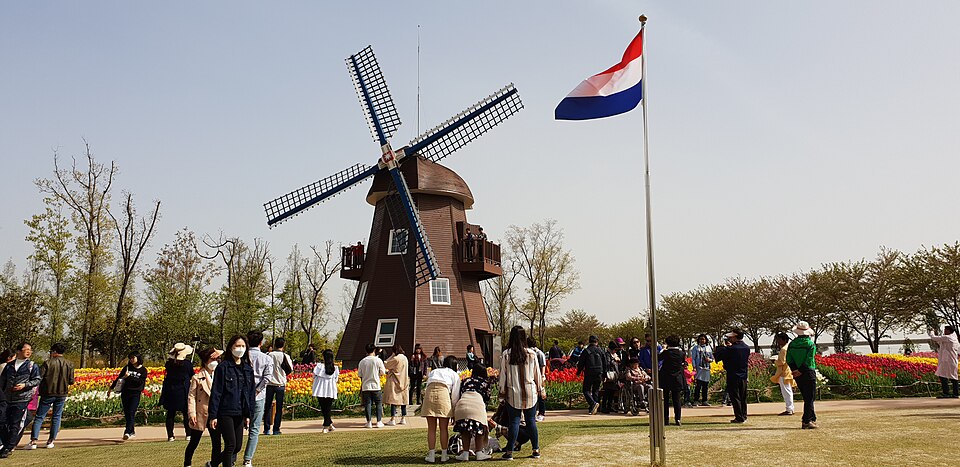
The Netherlands Garden at Suncheon Bay National Garden, photographed on 15 April 2018. Photo: Choi2451, “Netherlands garden in Suncheon Bay National Garden.jpg”, CC BY-SA 4.0, via Wikimedia Commons. Resized for display.

A garden photograph does something deceptive: it brings everything into bloom at once. Pictures from different months sit beside one another, making a place look permanently dressed for its best day. Suncheonman National Garden offers a more interesting reason to go. Its arrangements of land, water and planting invite you to notice how a landscape directs your attention, even when the flowers in your saved picture belong to another season.
Begin with a modest ambition: understand one garden well enough to remember its shape. Then choose another that handles space differently. A visit built around that comparison can have a clear beginning and ending without becoming a campaign to cover the entire map.
Read the lake as a design
Suncheon City's English tourism booklet identifies the Suncheon Lake Garden as a work by landscape designer Charles Jencks. It places it within a larger collection of themed, country-themed and participatory gardens. That makes the lake a useful opening chapter: a particular designer's work within a place made from many different garden ideas.
Look first at the whole arrangement from an available public viewpoint. Where does the water interrupt the land? Which line draws your eye onward? Then follow an open path and notice how the composition changes when you become part of it. The photograph you take from one position is only one reading of a place designed to be encountered while moving.
You do not need specialist vocabulary. Think in ordinary terms: open and enclosed, near and far, a long view and a small detail. If you are traveling with someone, choose the same spot to photograph independently. Comparing the results can reveal what each of you noticed before either person tries to explain why.
Choose a second garden with a different idea
The garden's own website groups its spaces into themes, including world traditional gardens and gardens shaped through participation. Use the current map to choose a contrast to the lake. A country name can help you find a place, but the more rewarding question is what its layout asks you to do.
Does a path encourage a direct approach, or does it make you turn before the main view appears? Are the plants the subject, or do they make a frame for something else? Stay on the visitor routes while looking for those choices. The point is to enjoy the arrangement, with enough attention left for small differences.
Let the actual planting set the color palette. Some days may offer flowers; others may make branches, leaves, water or open ground more noticeable. A garden visit can be satisfying in either case. Build your expectations around the place and the weather you have, then treat a particular bloom as something to confirm close to the date.
The photograph keeps one view. The walk shows you how the view was made.
Keep the garden and the wetland distinct
Suncheonman National Garden and Suncheonman Wetland have related names and separate arrival points. The city's booklet presents the garden as a designed attraction and the wetland as a coastal landscape of mudflats and reeds. Save the National Garden's exact entrance for this outing. Adding the wetland means making another destination decision, including its current access and transport arrangements.
There is plenty of purpose in letting the garden be the whole visit. After two contrasting spaces, you might return to the one you preferred, take another photograph or finish while the comparison is still fresh. Your memory can be specific: the place where water held the view, or the turn that changed what you could see.
For a wider Korea itinerary, our Gongju stream story follows water through an inhabited town, while our Yeouido feature builds a Seoul afternoon around the river. Each gives water a different role in a day outdoors.
Before choosing your entrance
- Destination: Suncheonman National Garden. The operator lists its West Gate at 47 Gukgajeongwon 1ho-gil, Suncheon. Save the gate you intend to use.
- October planning: KTO currently lists October–June hours of 09:00–20:00, with last admission at 19:00, and closure on the last Monday of each month. Check dated operator notices.
- Budget: The operator lists standard daytime adult admission at 10,000 won. Confirm your ticket category and any separately charged activity.
- Your subject: Choose a landscape or garden name first. Check current planting if a particular flower is essential to the trip.
Primary sources checked 27 October 2026: Suncheon City's English tourism booklet, the National Garden operator website and KTO's current destination listing.
'Visitor Guides' 카테고리의 다른 글
| The Model and the Street: Incheon Open Port in Two Scales (0) | 2026.10.27 |
|---|---|
| The River Holds the Village: Visiting Hahoe in Andong (0) | 2026.10.27 |
| Mokpo Open Port: The History Behind the Facades (0) | 2026.10.27 |
| Tongyeong at Three Levels: Gangguan, the Market and Dongpirang (0) | 2026.10.27 |
| Mangwon Market to the River: Let Lunch Lead the Afternoon (0) | 2026.10.27 |