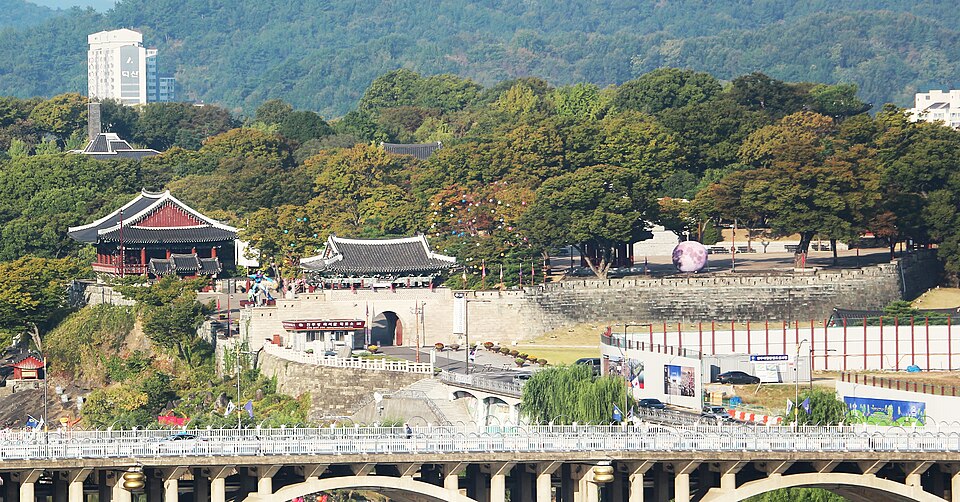
Jinjuseong Fortress in Jinju, photographed on 2 October 2022. Photo: Bernard Gagnon, “Jinjuseong Fortress 01.jpg”, CC0 1.0, via Wikimedia Commons. Resized for display.

Jinjuseong is more than a wall above the Namgang. A royal certificate inside the national museum, and a pavilion rebuilt beside the river, give a Jinju visit two unusually clear ways to consider how a battle becomes public memory.
Begin with a piece of paper
The Jinju National Museum’s Imjin War Hall guide includes a royal certificate honoring Kim Si-min for the victory at Jinju in 1592. Issued in 1604, the document was taken outside Korea during the colonial period and returned in 2006 through a public fundraising campaign. Its history continues long after the battle it commemorates.
That makes a useful starting point for the fortress. The certificate turns an enormous subject into something with a date, a purpose and a later journey. It also raises a question that a wall alone cannot answer: how do people preserve and recover the evidence of an event after those who experienced it have gone?
The museum frames the Imjin War of 1592–1598 as an East Asian conflict involving Joseon Korea, Japan and Ming China. Its permanent-exhibition account includes weapons alongside written records. For a first visit, this broader framework can keep local history from becoming a disconnected list of commanders and dates.
Plan time to read, rather than treating the museum as shelter between outdoor photographs. Check the current gallery information for what is on display; a collection or exhibition guide is not a promise that every named object will be available on your particular day.
Above the Namgang
Chokseongnu Pavilion stands above the river’s rocky cliffs. KTO traces its establishment to 1241 and describes two very different uses: a command post in wartime and a place for state examinations in peace. The same structure could be associated with military authority and with the selection of officials.
Those functions give the river view a context. From a permitted public viewpoint, consider the pavilion’s position in relation to the water and the fortified grounds. The pleasure of the landscape does not need to disappear when its history becomes more complicated. The point is to understand what occupied this advantageous position.
The present pavilion is also a rebuilding. It was destroyed during the Korean War and restored in 1960, according to KTO. Its attractive roof therefore should not be used as evidence that every part of the building has survived from the thirteenth century. The place’s long history includes destruction and the decision to build again.
Make the museum part of the fortress
Jinju National Museum is within the Jinjuseong compound. Treat the indoor and outdoor portions as one heritage visit, with enough space between them to absorb what you have read. You could begin with the war’s chronology, move to the pavilion and river, and finish with another stretch of the public grounds.
There is no need to force the walk into a complete circuit. Let the available time determine how much you add after the museum and pavilion. The document’s recovery and the pavilion’s reconstruction already provide a substantial thread: public memory depends on later acts of care as well as on the event being remembered.
For another fortress’s local history, the Haemieupseong feature follows the responsibilities recorded in its stones. Our Tongyeong story offers a different encounter with a southern city’s harbor and hillside.
Before entering
- Addresses: Jinjuseong is at 626 Namgang-ro; the museum is at 626-35 Namgang-ro, Jinju.
- Monday matters: The museum lists Mondays, New Year’s Day, Seollal and Chuseok as closures. Its schedule is separate from the fortress grounds.
- Admission: Check fortress entry conditions and museum visitor notices separately. This outing is built around permanent heritage, without depending on a seasonal event.
Official sources checked 29 October 2026: Jinju National Museum’s Imjin War Hall guide, KTO’s Chokseongnu Pavilion history and museum visitor information.
'Visitor Guides' 카테고리의 다른 글
| Dumulmeori, Yangpyeong: The Two Rivers Behind the View (0) | 2026.10.29 |
|---|---|
| Mireuksa Temple Site, Iksan: The Temple in Its Surviving Pieces (0) | 2026.10.29 |
| Ojukheon, Gangneung: A House Before It Became a Landmark (0) | 2026.10.29 |
| Korea Tourist Tax Refund: Immediate vs General Refunds (0) | 2026.10.29 |
| Haemieupseong, Seosan: The Town Names Written Into a Fortress (0) | 2026.10.28 |