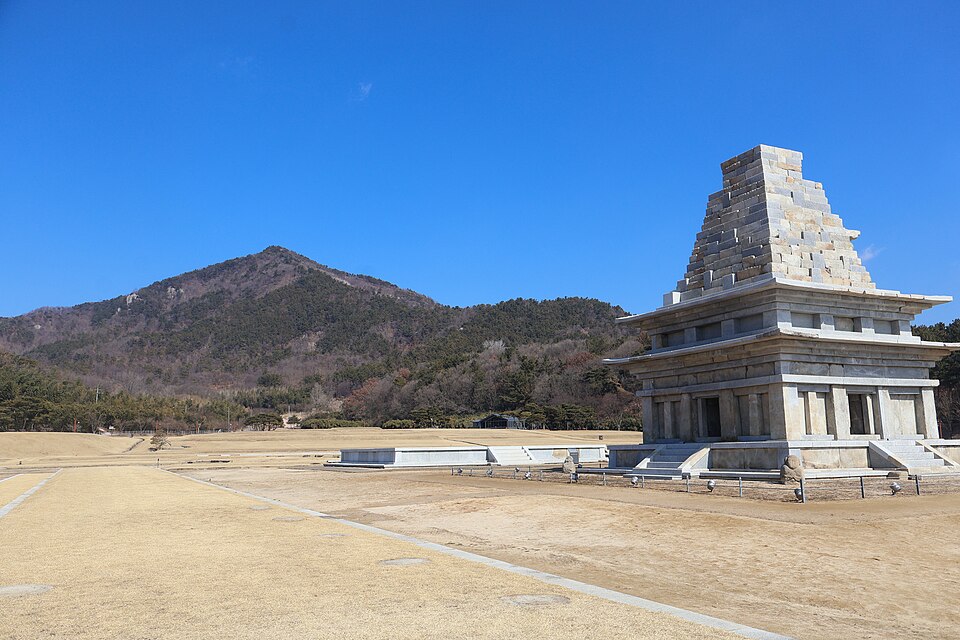
The stone pagoda at the Mireuksa temple site in Iksan, photographed on 24 February 2025. Photo: LandAndTree, “Mireuksaji Stone Pagoda Front View 20250224 (03).jpg”, CC BY-SA 4.0, via Wikimedia Commons. Resized for display.

Two pagodas give Mireuksa Temple Site its outline, but they are only the beginning. In Iksan, the rewarding visit connects a vanished Buddhist complex with the small, excavated things that explain how it was built and used.
Arrive at Mireuksa expecting an archaeological site. The missing halls are part of the subject. Instead of a sequence of furnished rooms, this visit asks you to consider a temple through surviving stone, documented reconstruction and objects recovered from its ground. Give the site and Iksan National Museum a place in the same outing.
Two pagodas, different histories
The west stone pagoda survives at six tiers. The nine-tier east pagoda was reconstructed in 1993. That difference is essential: the two towers are evidence of different kinds, even when a photograph brings them into a single composition. A reconstruction can suggest an earlier form, while surviving material carries the marks and limitations of what endured.
Use the site map to establish east and west before following the paths. A useful first question is simply which structure you are facing. This prevents a handsome overall view from becoming a misleading impression that both towers have arrived unchanged from the same ancient moment.
South of the pagodas are stone flagpole supports, another survival identified in KTO’s site account. Their name explains a practical function that is less immediately theatrical than a tower. Include them in your visit. A temple needed fittings and ways of organizing its grounds as well as a monumental skyline.
Mireuksa belonged to the Baekje kingdom and is now part of the UNESCO-listed Baekje Historic Areas. Its place in that wider history is useful context, but you do not need to collect several distant heritage sites on the same day. A concentrated visit here can be more satisfying than using the pagodas as a brief stop between cities.
The temple in smaller pieces
Inside Iksan National Museum, the scale of the evidence changes. The museum’s facilities guide identifies a reliquary from the west pagoda and building materials excavated from the temple site. These give the visit subjects beyond the towers: a container associated with Buddhist relics, and the components from which buildings were made.
A building fragment is especially useful when much of the building has disappeared. Read its label for its material and original role before looking for an exceptional story. Something made to finish a roof or join an architectural surface can explain repeated work across a large complex. The ordinary component belongs alongside the precious object.
The missing building makes its surviving pieces matter more.
Allow the indoor evidence to revise your understanding of the grounds. If you return outside afterward, follow the public paths and compare the scale of an excavated component with the space a temple building occupied. Keep observation separate from certainty: the interpretation can identify what is known, while a visitor’s mental picture will always fill in more than the stones themselves reveal.
For a wider look at heritage travel, our Gyeongju feature approaches royal burial landscapes, while the Jeonju story examines buildings that remain in everyday use.
Planning the two-part visit
- Destination: Mireuksa Temple Site and Iksan National Museum, 362 Mireuksaji-ro, Geumma-myeon, Iksan.
- Museum day: The operator lists Mondays, January 1, and the days of Seollal and Chuseok as closures. Check its current notice before planning the indoor portion.
- Allow for the grounds: Bring what you need for time outdoors and follow designated paths. The museum and the open archaeological site have separate visitor arrangements.
Official sources checked 29 October 2026: KTO’s Mireuksa Temple Site listing, Iksan National Museum’s exhibition and facilities guide and museum visitor information.
'Visitor Guides' 카테고리의 다른 글
| Dumulmeori, Yangpyeong: The Two Rivers Behind the View (0) | 2026.10.29 |
|---|---|
| Jinjuseong, Jinju: Stone Walls, War Records and the Namgang (0) | 2026.10.29 |
| Ojukheon, Gangneung: A House Before It Became a Landmark (0) | 2026.10.29 |
| Korea Tourist Tax Refund: Immediate vs General Refunds (0) | 2026.10.29 |
| Haemieupseong, Seosan: The Town Names Written Into a Fortress (0) | 2026.10.28 |