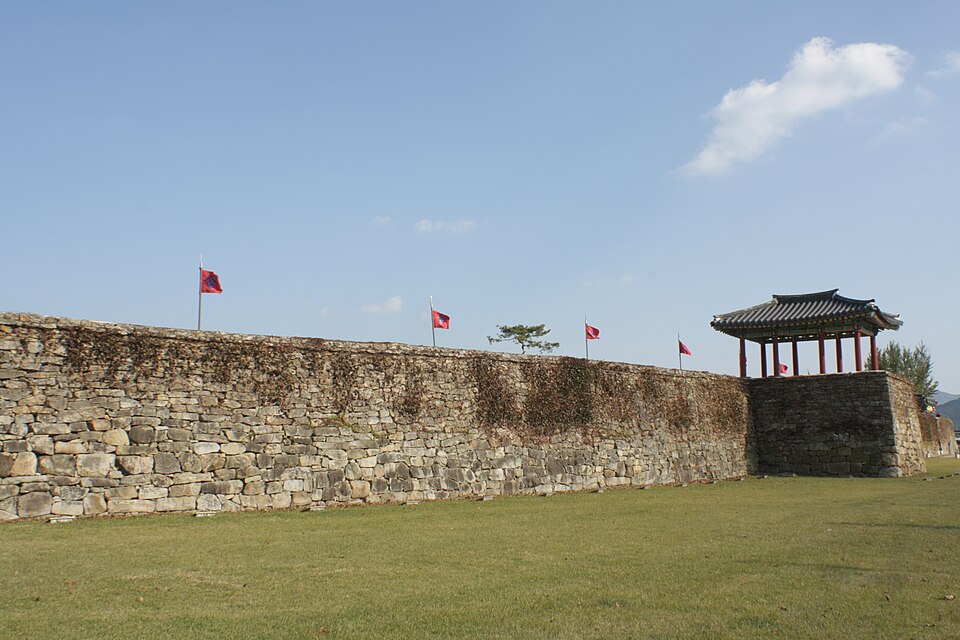
Haemieupseong in Seosan, photographed on 28 October 2010. Photo: Dalgial, “Haemieupseong.JPG”, CC BY-SA 3.0, via Wikimedia Commons. Resized for display.

At Haemieupseong in Seosan, a fortress wall is also a record of work. Town names cut into its stones offer an unusually concrete way into this Joseon site: begin with the people responsible for building it, then follow the stories held inside.
The Names in the Stone
A wall usually announces its purpose before its makers. Haemi offers a reason to reverse that order. Seosan City identifies names including Gongju, Cheongju and Imcheon on the exterior stones, relating them to the towns assigned responsibility for different sections of construction. A monumental defense becomes a set of jobs, with accountability attached.
That is a satisfying starting point for a visit. Approach the wall from the designated public paths and use the site interpretation to locate the inscribed stones. You do not need to climb onto masonry or trace the characters with your fingers. The important discovery is the system behind them: a large undertaking divided into smaller responsibilities.
Seosan dates the initial construction to 1417–1421, when a military headquarters was moved here to strengthen coastal defense. The word eupseong describes a walled settlement that enclosed administrative offices and residents. These were places for governing as well as defending, a distinction that helps explain the buildings inside.
Jinnammun, the main southern entrance, makes a more formal introduction. Seosan identifies a dated inscription connected with a 1491 rebuilding of the gate. Walk through it as an entrance to a former administrative world, with the wall’s labor history already in mind. The gate gives that dispersed work a single, deliberate point of arrival.
An Office, a Household, a Guest
Once inside, put the building names ahead of a complete perimeter circuit. Dongheon was the center of local official business. Naea was the magistrate’s family residence, and the guesthouse accommodated officials and envoys. The distinctions turn a general fortress visit into a small study of how a district was run.
These are roles worth separating. Public duties needed a place, a household needed another, and a traveling official brought yet another set of expectations. It is easy to treat the whole ensemble as royal architecture. Haemi’s story is more local and more administrative: the work of authority, conducted inside a defended boundary.
The wall held a town together; its stones still name part of the effort.
The site is presented as a historic park following restoration. Its prison is a reconstruction, and the domestic displays include recreated houses. Let the labels establish what you are seeing rather than assuming that every room or object has remained untouched for centuries. A reconstruction can explain a spatial relationship; an original inscription offers a different kind of evidence.
Seosan also records the fortress’s association with thorny trifoliate-orange plantings, which discouraged an approach to the walls and gave rise to its nickname, Tangjaseong. That defensive detail works at a smaller scale than a gate tower. A barrier could be botanical as well as stone, with everyday materials enlisted in the work of protection.
A Place of Remembrance
The prison story requires a change of tone. During late Joseon persecutions, Catholics were brought to Haemi and imprisoned and executed. The historic prison site and old tree are associated with that history. They belong in the visit alongside the fortifications, rather than as a dramatic footnote to a pleasant park walk.
Spend time with the interpretation before raising a camera. The human meaning of the site cannot be supplied by the size of a wall or the age of a tree alone. You can appreciate the construction while also acknowledging what local power meant for people detained here. Neither part of the history cancels the other.
Leave room after this section before moving on to lunch or another attraction. There is no need to create a photograph at every stop. A visit can finish with an understanding of why the same enclosure is remembered as a defense, an administrative center and a place of persecution.
For another view of life within historic boundaries, our Andong Hahoe Village story considers a living village. The Mokpo history feature explores how preserved buildings carry difficult public histories.
A small plan for Haemieupseong
- Find it: 143 Nammun 2-ro, Haemi-myeon, Seosan, Chungcheongnam-do.
- Shape the visit: Start with Jinnammun and the wall interpretation, continue to the administrative buildings, and give the prison and memorial history separate attention.
- Before leaving: Check Seosan’s official page for seasonal entry hours and notices. Performances, craft activities and festival dates need their own confirmation.
Official sources checked 27 October 2026: Seosan’s site history and visitor information, city heritage interpretation, and KTO’s destination listing.
'Visitor Guides' 카테고리의 다른 글
| Dongguksa, Gunsan: A Temple Corridor and the History Beyond It (0) | 2026.10.28 |
|---|---|
| Yangnim-dong, Gwangju: Houses, Meeting Rooms and the Things That Stayed (0) | 2026.10.28 |
| The Island in the Pond: Gungnamji, Buyeo (0) | 2026.10.28 |
| Written in Rows: The Tea Landscape at Daehan Dawon (0) | 2026.10.28 |
| Inside the Bamboo, Beside the River: Taehwagang in Ulsan (0) | 2026.10.28 |