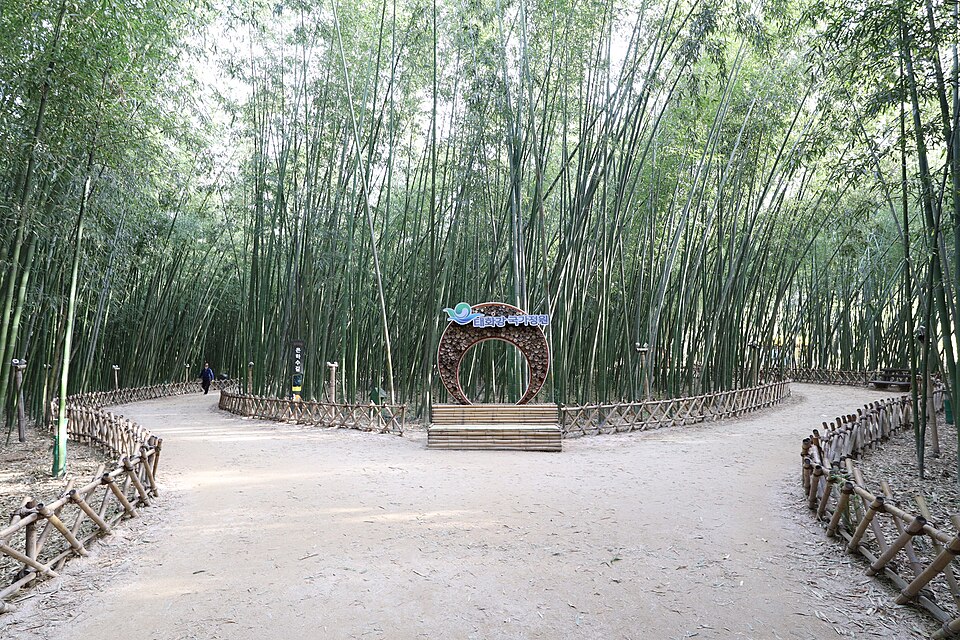
The bamboo grove at Taehwagang National Garden in Ulsan, photographed on 25 November 2022. Photo: Mobius6, “Taehwagang National Garden 20221125 050.jpg”, CC BY-SA 4.0, via Wikimedia Commons. Resized for display.

At Taehwagang, Ulsan's river landscape changes character inside the Simni Bamboo Grove. Pair a walk among the stems with time on an open riverside path, using the grove itself as your arrival point.
Bamboo makes a landscape legible in vertical lines. A stem, a joint, another stem: the repetition is the attraction. At Ulsan's Simni Bamboo Grove, that close-grained view sits within the much broader setting of Taehwagang National Garden. You can plan a visit around the change between those two scales, from a path through bamboo to a view across the river.
It helps to be precise about the destination. Taehwagang is a river through the city, and the national garden includes more than a single stand of bamboo. Save Simni Bamboo Grove on your map, then choose an entrance and an open riverside section nearby. A clear starting point is more useful than a route that tries to collect every garden name.
Find the grove within the garden
Ulsan's garden directory describes Simni Bamboo Grove as extending for about four kilometers along the Taehwagang. That figure explains the scale behind the name; it should not become an obligation to walk a four-kilometer circuit. Choose a section and a return point according to the paths that are open and the distance you want.
The city identifies Taehwagang National Garden with two districts, Taehwa and Samho, on different sides of the river. It became Korea's second national garden in July 2019. For this outing, let the bamboo be the anchor rather than treating those districts as one compact attraction with a single front door.
Once on a designated path, look along it before looking upward. The close spacing can make the view ahead feel different from a view across the planting. A camera held at eye level can record those lines without stepping into the grove. Keep the visitor route clear when stopping; another person's walk should not have to become part of your photograph.
Look beyond one kind of bamboo
The operator's directory also identifies a Bamboo Ecology Garden with 63 varieties from Korea, China and Japan. That gives a curious visitor another possible subject beyond the familiar image of a bamboo tunnel. Use the current site map to locate it, and let the labels establish which plant you are looking at.
Try comparing two labeled examples. You might notice differences in the appearance of the stems, the density of the leaves or the space between plants. A short note beside each photograph will help you remember the distinction later. There is pleasure in leaving with two names you did not know when you arrived.
Then take an open path toward the river. The city presents the garden as a riverside green space, and the contrast is part of its appeal: the bamboo offers a close view, while the water gives your eye somewhere farther to travel. Choose a suitable stopping place and let that broader view be a destination in itself.
Inside the bamboo, look at the lines. Beside the river, look at the space between them.
Choose daylight or make a separate evening plan
The garden's official directory lists Eunhasugil, the Milky Way Trail, as a distinct illuminated bamboo area. An evening visit therefore has its own subject and operating arrangements. If the lights are the reason for your journey, check the current operator notice before committing to a late arrival.
A daytime visit can stand on its own. You have the grove, the ecology collection if it suits your route, and a riverside pause. That is enough structure for an outing without depending on a seasonal flower display, a festival or an evening lighting schedule.
Before leaving your accommodation, check your route to the specific entrance and your onward transport. The official tourism page lists general garden access at all times, with exceptions for individual facilities. Treat a visitor center, a booked activity or an illuminated area as a separate check rather than extending the general grounds' access conditions to everything inside.
For other kinds of city green space, our Seoul Forest story follows a sculpture, pond and paths. Our Yeouido picnic feature gives a Seoul riverbank a modest afternoon brief. Taehwagang's particular pairing is closer and wider: bamboo first, then the river around it.
Save the grove, then choose the route
- Arrival pin: Ulsan's visitor guide gives Simni Bamboo Grove as 154 Taehwaganggukgajeongwon-gil, Jung-gu, Ulsan. Check your actual entrance on a current map.
- Admission: The city lists general admission as free and the grounds as always open; individual facilities have exceptions.
- Day or night: Eunhasugil is a particular illuminated area. Confirm its latest operating notice if it is essential to your plan.
- Distance: Pick an out-and-back section or your own return point. The grove's overall length is not a timed visitor route.
Visitor references: Ulsan's garden and bamboo directory, Eco Tour introduction and visitor access guide.
'Visitor Guides' 카테고리의 다른 글
| The Island in the Pond: Gungnamji, Buyeo (0) | 2026.10.28 |
|---|---|
| Written in Rows: The Tea Landscape at Daehan Dawon (0) | 2026.10.28 |
| Seomun Market by Day: Cloth, Flat Dumplings and a Proper Daegu Lunch (0) | 2026.10.28 |
| Pines, Stone and a Glasshouse: A Daejeon Afternoon at Hanbat (0) | 2026.10.28 |
| Room Between Appointments: An Everyday Visit to Seoul Forest (0) | 2026.10.27 |