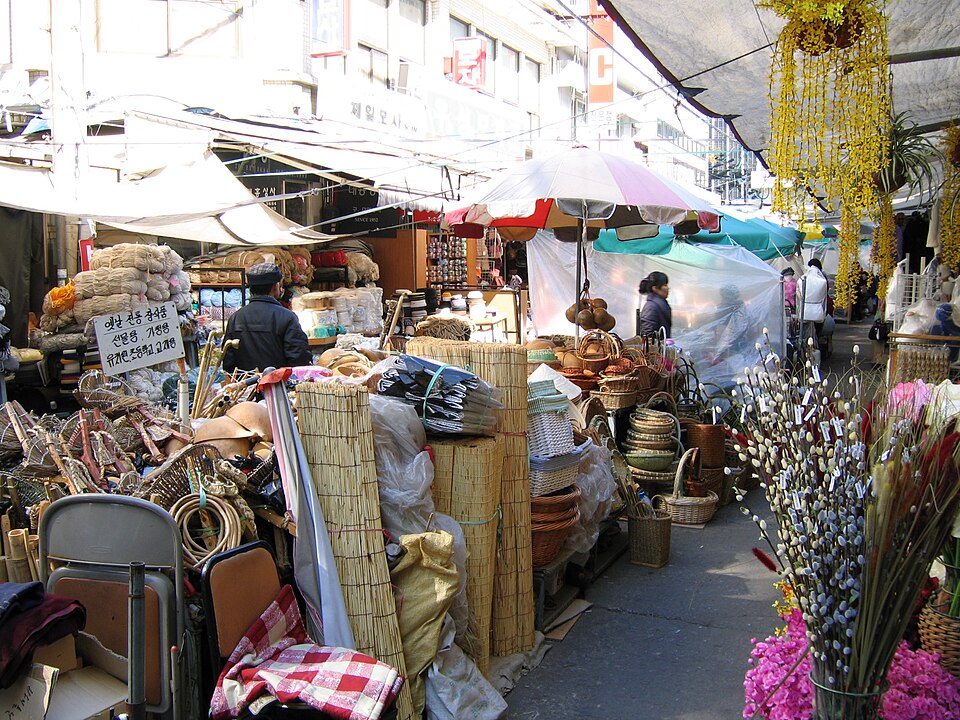
Seomun Market in Daegu, photographed in March 2005. Photo: Thorfinn Stainforth (Peregrine981), “Seommunmarket2005.JPG”, CC BY-SA 3.0, via Wikimedia Commons. Resized for display.

At Daegu’s Seomun Market, lunch shares an address with bolts of cloth. Give the daytime market room in your itinerary: the textile counters are as much a reason to come as the flat dumplings and noodle bowls.
Cloth Before Lunch
A market lunch can begin with something you cannot eat. Start your Seomun visit among the fabric and clothing sellers, with your first meal still ahead of you. It changes the outing’s proportions. Food becomes part of a working district, rather than a string of dishes collected for the camera.
Textiles remain a principal trade here. KTO’s destination listing places silk, clothing, household goods and dried seafood within the market’s wider mix. The name Seomun refers to its earlier position west of Daegu Fortress; the market moved to its present site in the 1920s, on reclaimed reservoir land. Its history belongs to the city’s commercial geography, not simply to a recipe.
For a visitor, cloth offers a satisfying reason to linger without making an immediate purchase. A folded length of material and a finished garment ask different questions: what is it made from, how is it sold, what would it become? If you want to buy fabric, ask the seller about the unit and the final amount before anything is cut. Photographing a textile display is also a good moment to ask permission rather than move a phone into someone’s workspace.
Leave the temptation to label every object behind. You can appreciate a color combination without knowing its intended occasion. This part of the visit works best as ordinary shopping: an interested customer speaking to a seller, with a practical exchange at its center.
Thin Dumplings, Two Kinds of Dough
When lunch calls, two useful names distinguish Seomun from a generic Korean street-food stop. Napjak mandu, Daegu’s flat dumplings, have thin wrappers with a modest filling of glass noodles and chives. KTO describes them cooked on an oiled iron plate, sometimes eaten alongside tteokbokki. Kaljebi puts knife-cut noodles and hand-torn dough pieces in the same bowl; the tourism organization’s account describes an anchovy broth.
Those descriptions are introductions, not a specification every kitchen must follow. Look at the actual menu and ask about the bowl being served. The dumplings suggest a smaller first order; kaljebi suggests sitting down to lunch. There is no obligation to fit both into one stomach, particularly when the rest of your day still involves walking.
A good market lunch leaves space for the market around it.
Order in a way that suits the table you have, rather than the entire list you saved beforehand. If you are sharing, establish the number of portions with the vendor. If you are dining alone, let one satisfying dish be the meal. A clear order and room for the next customer do more for the encounter than an elaborate tasting itinerary.
The pleasure here can be quite specific: learning the difference between a noodle and a torn piece of dough, or understanding why a thin dumpling is treated as its own local dish. You do not need a verdict on which stall is the best to carry that knowledge into your next meal.
The Day Shift
Plan this as a daytime market visit. Seomun also has a separately scheduled night market, but an evening food program is not a promise that the textile shops will be operating. The distinction matters if cloth, clothing or household shopping is part of your reason for coming.
Make a modest circuit after eating, returning to a counter that caught your attention earlier. That gives a possible purchase a second thought and puts lunch in the middle of the outing, where it belongs. You might leave with fabric, a small household object, or simply a new dish name. None needs to become a souvenir assignment.
For another market story, our Gwangjang lunch feature approaches a Seoul meal through its own food culture. The Korea payment guide can help with the practical side of buying from individual sellers.
A small plan for Seomun
- Find it: 45 Keunjang-ro 26-gil, Jung-gu, Daegu. Seomun Market Station is on Daegu Metro Line 3.
- Pick the date: KTO lists the first and third Sundays as regular closing days, with closures and hours varying by shop. Recheck the listing before setting out.
- At the counter: Confirm the item, portion or fabric quantity, and price with the seller. Day-market shopping and the night-market schedule are separate plans.
Official sources checked 27 October 2026: KTO’s Seomun Market destination listing, Seomun food feature and Daegu shopping course.
'Visitor Guides' 카테고리의 다른 글
| Written in Rows: The Tea Landscape at Daehan Dawon (0) | 2026.10.28 |
|---|---|
| Inside the Bamboo, Beside the River: Taehwagang in Ulsan (0) | 2026.10.28 |
| Pines, Stone and a Glasshouse: A Daejeon Afternoon at Hanbat (0) | 2026.10.28 |
| Room Between Appointments: An Everyday Visit to Seoul Forest (0) | 2026.10.27 |
| The Model and the Street: Incheon Open Port in Two Scales (0) | 2026.10.27 |