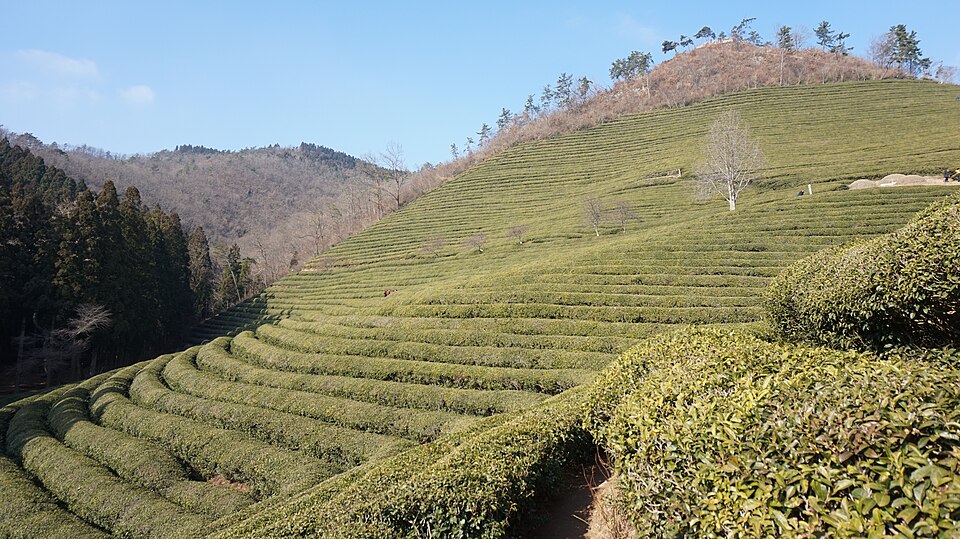
Tea fields at Daehan Dawon in Boseong, photographed on 1 January 2016. Photo: Jocelyndurrey, “대한다원 차밭.JPG”, CC BY-SA 4.0, via Wikimedia Commons. Resized for display.

At Daehan Dawon in Boseong, the approach through tall cedars leads to the precise lines of a tea hillside. Give both landscapes time, and choose how much climbing belongs in your visit.
The photograph everyone recognizes is a hillside written in rows. Daehan Dawon's tea planting gives the land a repeated line, with each band helping the next one become visible. But the approach matters, too. KTO's destination guide describes tall cedars at the entrance: an upright forest before the lower, cultivated forms of the tea field.
That sequence gives a visit a natural beginning. Arrive at the actual plantation, follow the open visitor route through the trees and let the first view of the fields come in its own time. You can decide how far to climb after seeing the paths and the day's conditions.
The cedars are part of the visit
Begin with the entrance path instead of treating it as a corridor to hurry through. Look at the relationship between the trees and the route beneath them. The vertical trunks make a useful counterpoint to the horizontal repetition you have come to see on the hillside.
For photographs, keep the two subjects distinct at first. A frame along the cedar path can concentrate on depth and spacing. At the tea field, a wider view can show the planting's pattern across the ground. You do not need the same angle as a promotional image to bring home a recognizable sense of the place.
Stay on visitor routes and leave the tea planting to the people responsible for it. The rows are the subject of the photograph, rather than an invitation to step between bushes wherever a camera angle looks tempting. A longer view from a permitted position can explain the landscape better than a close-up taken inside the crop.
Choose your height on the hillside
KTO identifies a summit observation deck and describes sea views in clear conditions. That is a conditional possibility, not a requirement for a successful visit. Treat any higher path as a separate choice once you have checked its current access, footing and suitability for your group.
A visitor interested in the pattern of the tea rows may be satisfied much earlier. Pause where the route allows and see how the lines overlap from the position you have reached. If you continue upward, stop again and compare the view. A change in height can make the geometry easier to understand, while the effort and return journey remain part of the decision.
Choose shoes for an outdoor hillside and leave enough time to return comfortably before closing. Rain, heat and the condition of the path can change what makes sense. Anyone who needs a route with limited steps should ask the operator about the specific section they want to use, rather than assuming that the main field viewpoint and summit have the same access.
The hillside gives the tea its pattern; your stopping point gives the visit its scale.
Let the landscape sharpen your questions about tea
If you want to buy tea afterward, the plantation can give that purchase a more specific starting point. Daehan Dawon's tea information page distinguishes grades such as ujeon, sejak and jungjak by the stage or timing of leaf picking. Those names are worth noticing on a packet, while the particular product's label supplies the details of what you are buying.
Ask about the harvest year, whether the tea is loose leaf or bagged, and how the seller suggests preparing that product. A familiar landscape on the package can be appealing, but it does not tell you the format or quantity inside. Choose something you can use at home with the equipment you actually have.
Give equal attention to getting back. The operator's transport page labels its displayed bus timetable as November 2021. Use current transport information to confirm today's outward and return journeys, and save the correct roadside boarding point before leaving the entrance area. A fixed train or onward bus needs a transport plan of its own.
For more landscape-focused travel in southern Korea, our Suncheon garden story looks at designed views. Our Mokpo feature turns toward the buildings of a port city. Daehan Dawon offers a different kind of structure: a cultivated hillside, read one row at a time.
Before setting out for the fields
- Exact destination: Daehan Dawon Tea Plantation, 763-65 Nokcha-ro, Boseong. Use the plantation entrance pin when planning the last part of the journey.
- Seasonal hours: KTO lists March–October at 09:00–18:00 and November–February at 09:00–17:00. Recheck the operator's current admission notice before travel.
- Tickets: Paid entry applies. Confirm the current price and concession category with the operator.
- Your route: Choose the field views first; add a higher viewpoint only if the open path, weather and your group's needs suit it.
Visitor references: KTO's Daehan Dawon listing, the operator's admission notice, tea-grade guide and transport information.
'Visitor Guides' 카테고리의 다른 글
| Yangnim-dong, Gwangju: Houses, Meeting Rooms and the Things That Stayed (0) | 2026.10.28 |
|---|---|
| The Island in the Pond: Gungnamji, Buyeo (0) | 2026.10.28 |
| Inside the Bamboo, Beside the River: Taehwagang in Ulsan (0) | 2026.10.28 |
| Seomun Market by Day: Cloth, Flat Dumplings and a Proper Daegu Lunch (0) | 2026.10.28 |
| Pines, Stone and a Glasshouse: A Daejeon Afternoon at Hanbat (0) | 2026.10.28 |