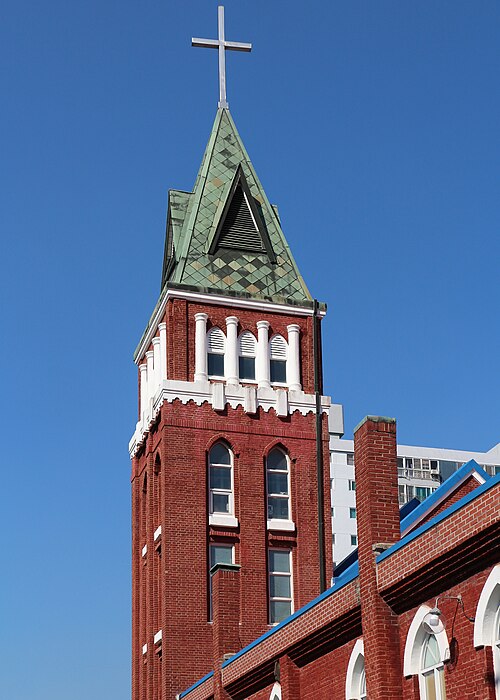
Yangnim Church in Gwangju, photographed on 30 September 2022. Photo: Bernard Gagnon, “Yangnim Church.jpg”, CC0 1.0, via Wikimedia Commons. Resized for display.

A hanok, a missionary’s residence and walls of reused household objects: Yangnim-dong’s history has several different scales. Build a Gwangju afternoon around the homes and institutions of this neighborhood, then leave time for the smaller things its residents have chosen to keep.
A House With an Angle
Begin with a house rather than a panoramic account of the city. Yi Jang-u’s House gives this walk a precise point of departure. KTO dates the hanok to around 1899 and describes its bent, L-shaped plan and courtyard garden. Even before considering its age, that arrangement offers a useful architectural idea: a home can turn inward, using its own outline to organize life around a yard.
When the property is open to visitors, take the courtyard as the center of your attention. It helps to resist treating the entire building as a single decorative roof. The relation between rooms, entrances and an open middle is the more interesting subject. Follow the areas designated for visitors; an appealing doorway is not an invitation to enter a private room.
The neighborhood’s Western-style houses belong in the same conversation. Missionary Robert M. Wilson’s residence, also identified by his Korean name Woo Il-seon, dates to the 1920s in KTO’s architectural account. The organization notes Korean elements within its predominantly Western design. That mixture makes a simple East-versus-West comparison inadequate. Buildings can borrow, adapt and answer local needs without fitting neatly into one visual category.
Put the two house names on your map before setting out. This is a better foundation for an afternoon than an undifferentiated pin marked “historic village.” It gives your walk real destinations, while leaving the streets between them free of a rigid sequence.
Rooms for a Larger Community
Yangnim’s history extends beyond domestic architecture. KTO identifies the district with the arrival of Western ideas and with missionaries’ roles in medicine and education. Homes, places of worship and institutions therefore belong to an interconnected neighborhood story. A residence was not necessarily isolated from the work happening around it.
Owen Memorial Hall adds another type of room. KTO’s Yangnim coverage places it in front of Yangnim Church and identifies it as a memorial to Clement Owen, an early missionary in Gwangju. It gives a building a person’s name, a relationship worth retaining as you move beyond the attraction label.
A neighborhood’s history lives in what its buildings were asked to do.
Approach these places as individual properties with individual uses. An afternoon walk can include public-facing exteriors even when an interior is unavailable, but it should not depend on unrestricted access to every building. Check the posted visitor information and any campus or institutional boundary before proceeding. Architecture remains worth considering from the space in which you are welcome.
This distinction also improves the story you take away. “Old building” says very little. A home organized around a courtyard, a residence shaped by a different architectural vocabulary, and a hall commemorating a named person give the district a more human structure. They connect its architecture with the people and purposes that shaped it.
The Things That Stayed
Penguin Village introduces a different register. Behind Yangnim-dong Community Center, residents turned discarded objects and neglected spaces into wall displays; the craft street also includes workshops working with materials such as leather, textiles and wood. These are household-scale acts of reuse alongside the district’s more formal heritage.
Allow this final part of the walk to be lighter without making it trivial. A saved object can carry a domestic history that a large memorial cannot. You need not know its former owner or invent a story about its use. Its selection and placement are already part of the neighborhood’s public expression.
If you enter a workshop, browse as a customer and ask about the actual objects on sale. Participation sessions and opening times need checking separately. Keep the residential lanes clear, and ask before photographing someone or the inside of a working space.
For further architectural travel, our Incheon Open Port feature follows a different urban history, while the Mokpo history walk considers the meanings behind preserved buildings.
A small plan for Yangnim-dong
- Map the houses: Yi Jang-u’s House is at 21 Yangchon-gil; Wilson’s residence is at 20 Jejung-ro 47beon-gil, Nam-gu, Gwangju.
- Check individual access: Neighborhood streets, historic homes and institutions do not share one opening schedule. For guided-tour enquiries, KTO lists +82-62-676-4486.
- Craft-street timing: KTO lists Monday closure for Penguin Village Craft Street. Recheck the listing and individual workshops before planning purchases or a session.
Official sources checked 27 October 2026: KTO’s Yangnim village introduction, Gwangju architecture feature, Yangnim neighborhood coverage and Penguin Village Craft Street listing.
'Visitor Guides' 카테고리의 다른 글
| Haemieupseong, Seosan: The Town Names Written Into a Fortress (0) | 2026.10.28 |
|---|---|
| Dongguksa, Gunsan: A Temple Corridor and the History Beyond It (0) | 2026.10.28 |
| The Island in the Pond: Gungnamji, Buyeo (0) | 2026.10.28 |
| Written in Rows: The Tea Landscape at Daehan Dawon (0) | 2026.10.28 |
| Inside the Bamboo, Beside the River: Taehwagang in Ulsan (0) | 2026.10.28 |