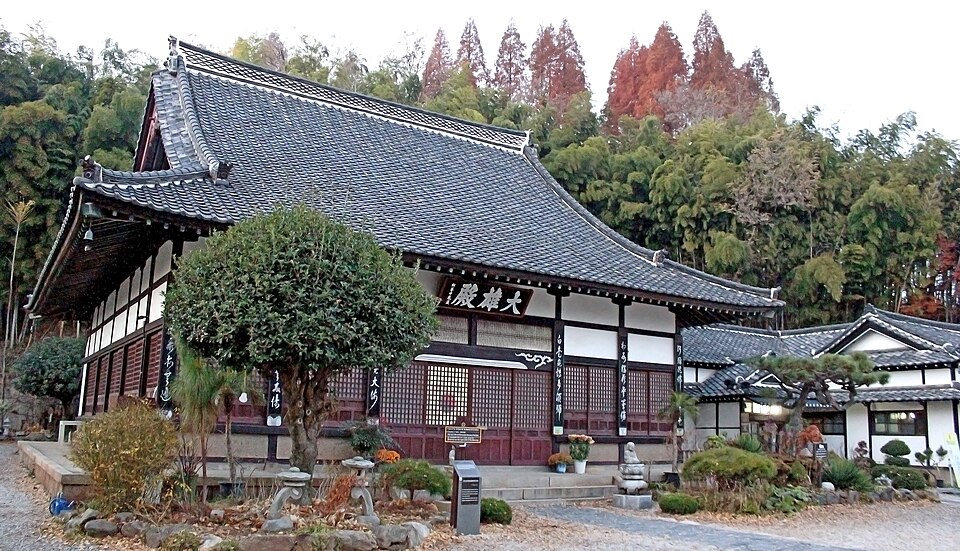
Dongguksa in Gunsan, photographed on 27 November 2014. Photo: Minseong Kim, “Dongguksa.jpg”, CC BY-SA 4.0, via Wikimedia Commons. Resized for display.

A corridor, a plain eave and a stone statement of apology give Dongguksa an unusual architectural story. Visit this Gunsan temple for the relationship between its Japanese origins, its life as a Korean Buddhist place of worship and the history it now asks visitors to confront.
The Corridor Between
Start with the connection between two buildings. Dongguksa’s Daeungjeon, the main worship hall, is joined by an enclosed corridor to the monks’ living quarters, or yosachae. That practical link is a useful introduction to a temple whose architecture differs from the brightly painted image many travelers associate with Korean Buddhist sites.
KTO’s architectural description points to plain eaves and lattice windows, without the multicolored dancheong decoration familiar at many Korean temples. Give those features their own attention. A building does not need a crowded surface to reward a close examination; the arrangement of openings and the connection between spaces can do the work.
Make the exterior your starting point rather than assuming the hall will be available for sightseeing. The corridor helps explain how the temple was organized, but it is not a visitor route by default. Follow the signs that distinguish public areas from the spaces used by the resident community.
The most useful comparison is specific. Consider a window, an eave or the way one building reaches another. Broad labels such as “Japanese-style” can establish a context, but they tell you less about a structure than a feature you can identify and place within its daily use.
A Temple That Continued
Gunsan City traces the temple’s origins to a Japanese Sōtō Buddhist mission established in 1909, known as Geumgangsa. It later acquired the name Dongguksa under Korean Buddhist stewardship after liberation. Today KTO identifies it as a branch of Seonunsa within the Korean Jogye Order.
That continuity matters to the visit. This is a place of Buddhist practice, as well as a historic building. Preservation has not turned it into an empty architectural specimen. The care you take with noise, entrances and photography belongs to its present life, not just to respect for an old structure.
The objects inside also have their own chronology. Gunsan City dates the clay Buddhist triad to 1650 and records its earlier home at Geumsansa. The sculpture is therefore older than the temple’s twentieth-century origins. Building and sacred objects cannot be compressed into a single date, or a single national style.
A building can survive a change of power without leaving its history behind.
If worship or an activity is taking place, give it priority. Enter only where visitors are permitted, follow the local shoe-removal instructions, and ask before making interior photographs. An exterior visit still offers a coherent architectural encounter; access to every room is not the measure of whether the stop was worthwhile.
A good visit here holds two ideas together: the form inherited from a Japanese Buddhist foundation and the Korean religious community that continued to use it. Neither is just a caption beneath a photograph. Their relationship is the reason the building deserves more than a quick stop.
An Apology in Stone
The courtyard’s statement of repentance makes the colonial context explicit. Gunsan City records that a stone monument was erected in 2012, carrying part of an earlier Sōtō statement acknowledging the sect’s involvement in Japanese imperial expansion and colonial policies. Korean and Japanese texts appear alongside one another.
Read the interpretation before treating the monument as another architectural detail. Its subject is responsibility. The presence of an apology within the temple grounds gives the visit a different weight from admiration of a roofline alone. It asks what an institution does with the history it inherits.
For further context, the History Center of the Japanese Colonial Period in Gunsan, at 21 Dongguksa-gil, addresses exploitation, remembrance, human rights and peace through records and exhibitions. It is a relevant extension if open, rather than a requirement to complete an extensive port itinerary.
Our Mokpo history walk considers another city’s preserved colonial-era buildings. The Jeong-dong afternoon feature offers a different encounter with architecture and public memory in Seoul.
A small plan for Dongguksa
- Find it: 16 Dongguksa-gil, Gunsan, Jeonbuk. Use the official destination listing to check current seasonal entry information.
- On site: Begin outside the hall, keep residential spaces private, and follow the temple’s instructions for entry and photography.
- If adding the history center: KTO lists Monday closure, plus January 1 and the days of Seollal and Chuseok. Check its current notice before planning an indoor visit.
Official sources checked 27 October 2026: Gunsan City’s Dongguksa interpretation, KTO’s temple architecture coverage, Dongguksa destination listing and colonial-period history center listing.
'Visitor Guides' 카테고리의 다른 글
| Haemieupseong, Seosan: The Town Names Written Into a Fortress (0) | 2026.10.28 |
|---|---|
| Yangnim-dong, Gwangju: Houses, Meeting Rooms and the Things That Stayed (0) | 2026.10.28 |
| The Island in the Pond: Gungnamji, Buyeo (0) | 2026.10.28 |
| Written in Rows: The Tea Landscape at Daehan Dawon (0) | 2026.10.28 |
| Inside the Bamboo, Beside the River: Taehwagang in Ulsan (0) | 2026.10.28 |