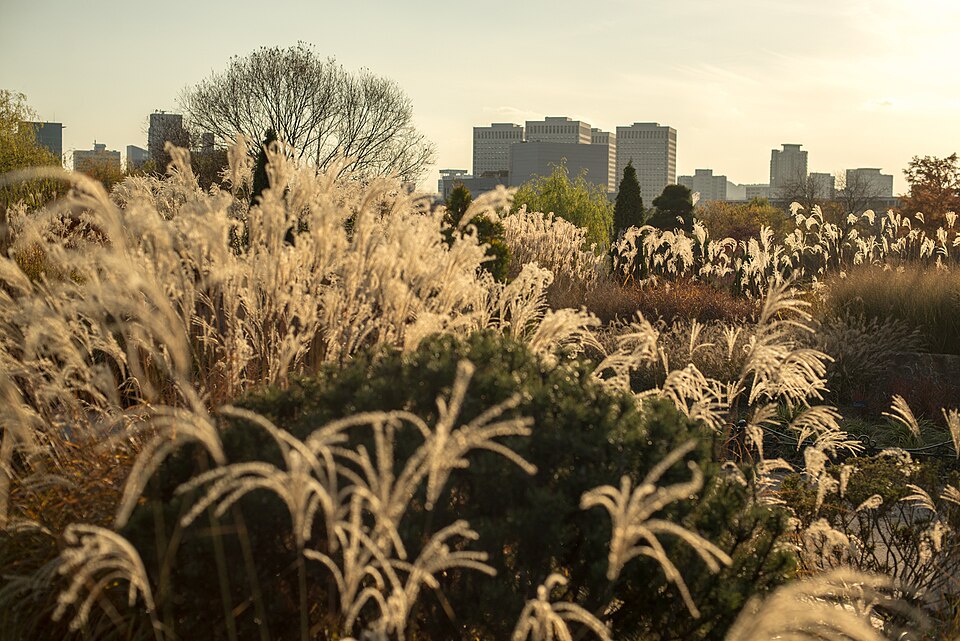
The East Garden at Hanbat Arboretum, photographed on 17 November 2021. Photo: Patrick M. Lydon (Pmlydon), “View from the East Garden in Daejeon Hanbat Arboritum, Daejeon, Korea.jpg”, CC BY-SA 4.0, via Wikimedia Commons. Resized for display.

Hanbat Arboretum turns a Daejeon city visit into a choice between woodland collections, themed gardens and a tropical glasshouse. Start with the section that is open, then let a few named plants lead the walk.
A pine grove, a rock garden and a mangrove collection make an unlikely trio for a city afternoon. At Hanbat Arboretum, they belong to the same destination, but each asks you to look differently. The woodland puts trees in company; a themed garden arranges a particular subject; the glasshouse introduces plants whose growing conditions need a building around them.
The useful first decision is which part to visit. Hanbat's East Garden and West Garden close on different weekdays, and the Tropical Garden has its own admission deadline. Knowing that before you arrive makes the map easier to read and leaves more attention for what is growing.
Two gardens, two ways of grouping plants
The operator's garden map gives the West Garden a vocabulary of woods: pine, several kinds of oak, willow and a wetland garden. The East Garden's named collections include maple, magnolia, rock-garden and medicinal plants. These are practical clues for choosing a route, rather than a list you need to complete.
If the West Garden is open, choose a tree group and a contrasting waterside collection. Look at the way trunks divide the view, then at what changes near the wetland planting. You can follow the map's names without needing to identify every species. A photograph of a label beside a photograph of the plant makes a useful pair to keep.
In the East Garden, let the Rock Garden be a possible starting point. Consider how the planting works with the stone and how close you can look from the permitted path. A second stop in the Maple Garden or another open collection gives the outing a different scale. The names describe collections; they do not guarantee flowers or autumn color on a particular day.
A glasshouse with a specific subject
Hanbat's Tropical Garden is more than an indoor substitute for a wet afternoon. The operator describes six themed sections, including mangroves, palms, tropical rainforest plants and succulents. Its mangrove collection makes an especially distinctive subject: plants associated with tropical or subtropical tidal ground are being cultivated in an inland city.
Read the plant labels before deciding which specimen deserves a closer look. You might compare the outline of a palm with the more compact forms in the succulent section, or look for the structural details described beside a mangrove. The collection gives you named examples, while the labels keep observation grounded in the plant in front of you.
Keep the glasshouse's earlier closing arrangements in mind. If it is essential to your visit, put it before a long outdoor walk. Check the current announcement before arranging the rest of your day around a particular collection.
A good arboretum visit can be measured by the plants you remember, rather than the ground you cover.
Make it a Daejeon outing
The arboretum's address is 169 Dunsan-daero in Seo-gu. Its official transport guide names Government Complex Daejeon Station, Exit 3, as a subway approach. Match that approach to your chosen garden entrance on a current map; the station name alone does not identify the gate you want.
The operator also lists the Daejeon Museum of Art and Lee Ungno Museum among nearby cultural places. Either can give the day another focus if its current exhibition and opening arrangements suit you. Choose an actual exhibition before adding an indoor stop, and allow time for a meal without turning the arboretum into something squeezed between appointments.
For a longer Korea trip, our Suncheon garden story considers a designed landscape at a different scale. Our Seoul Forest feature follows a permanent city park. Hanbat's particular pleasure is the collection: a place where the map can teach you what to look for.
Choose the right section
- Outdoor gardens: The operator lists April–October viewing at 05:00–21:00, with entry until 20:00; November–March viewing at 07:00–19:00, entry until 18:00.
- Closures: East Garden and Tropical Garden close Mondays; West Garden closes Tuesdays. The operator specifies normal opening when the closure coincides with a public holiday.
- Tropical Garden: 09:00–18:00, entry until 17:30. General arboretum admission is free.
- On foot: Use designated observation paths. The operator prohibits bringing or riding bicycles, scooters and similar equipment inside.
Visitor references: Hanbat Arboretum's opening and admission guide, East and West Garden map, Tropical Garden introduction and directions.
'Visitor Guides' 카테고리의 다른 글
| Inside the Bamboo, Beside the River: Taehwagang in Ulsan (0) | 2026.10.28 |
|---|---|
| Seomun Market by Day: Cloth, Flat Dumplings and a Proper Daegu Lunch (0) | 2026.10.28 |
| Room Between Appointments: An Everyday Visit to Seoul Forest (0) | 2026.10.27 |
| The Model and the Street: Incheon Open Port in Two Scales (0) | 2026.10.27 |
| The River Holds the Village: Visiting Hahoe in Andong (0) | 2026.10.27 |