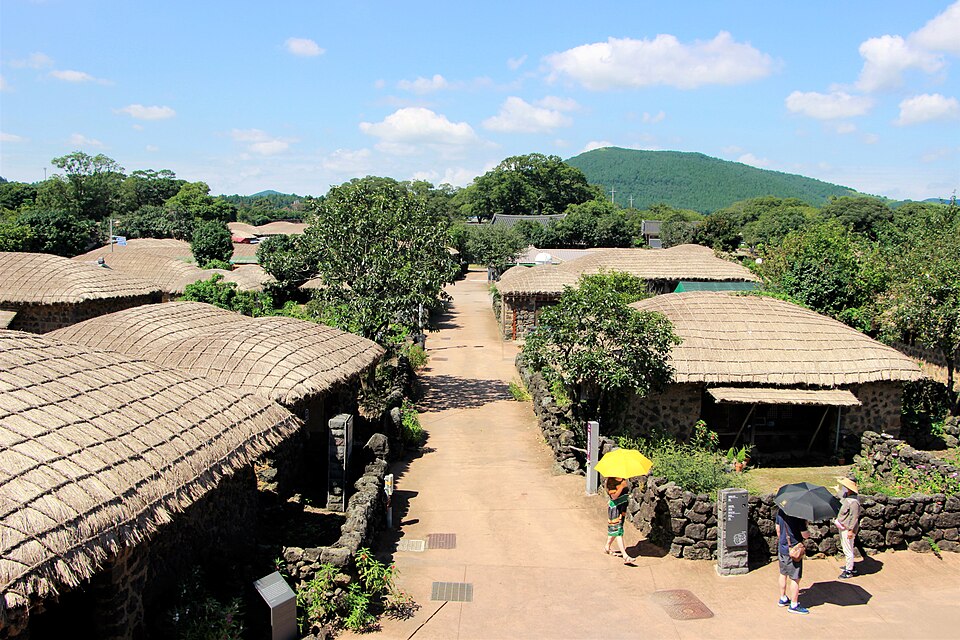
Seongeup Folk Village on Jeju, viewed from the south gate on 9 September 2021. Photo: Trainholic, “Seongeup Historic Village.jpg”, CC BY-SA 4.0, via Wikimedia Commons. Resized for display.

At Seongeup Folk Village on Jeju, stone walls and thatched roofs belong to a place where people still live. The entrance alleys, shared yards and old public buildings offer a close look at how island architecture organized both family life and a county town.
An entrance can reveal a house by delaying the view of it. Jeju’s traditional olle is the alley between a public road and a home. The Jeju Tourism Organization describes its deliberate curve, which helps keep the house out of a passerby’s direct sight. That small turn is a useful starting point for understanding Seongeup.
The bend in the entrance
From a public lane, consider how a stone boundary guides the approach to a house. The walls and the bend make a transition between the village and the household. A visitor can appreciate that relationship while remaining outside an entrance that is private.
Thatch supplies another practical detail. The tourism organization’s housing account explains the traditional use of dried silver grass for roofing and protection against weather. Roof coverings and their maintenance belong to the work of keeping a house habitable. They deserve attention as construction, as well as as a recognizable Jeju silhouette.
The same account describes a traditional arrangement of an inner and outer house, each with a kitchen, sharing a yard. Married children could form another household within that setting. The plan accommodated connection and independence at the same time, with family relationships expressed through separate buildings and common ground.
Use that description as background rather than a rule imposed on every home you pass. Individual buildings have their own histories, changes and present uses. Where a property is designated for visitors, let its own interpretation explain the layout. Elsewhere, a view from the public route is enough.
These details also help you avoid treating every thatched roof as a stand-alone object. A roof belongs to a household arrangement, and the household belongs to the lanes and public places around it.
A village that governed a district
Seongeup was the administrative center of Jeongui-hyeon. Jeju’s village account identifies Jeongui Hyanggyo as a place of education and rites, and Geunminheon as the office where the local magistrate worked. The village therefore includes public institutions as well as domestic architecture.
Give one of those named places attention during your visit. A school and ritual space, an administrative office and a family yard met different needs. Identifying a building’s purpose is more useful than attaching the same broad label of “old house” to everything.
The tourism organization also points to the village’s zelkova and hackberry trees as protected natural heritage. They add another kind of continuity to the built setting. Use the public paths and interpretation around them, leaving the trees and their surroundings undisturbed.
Seongeup’s cultural heritage extends to living practices, including local speech, folk songs and craftsmanship, as KTO notes. A quiet walk cannot reveal all of that by itself. If you want an introduction from a guide or a hands-on activity, confirm the current arrangement in advance rather than expecting an unscheduled performance.
Residents’ privacy should shape the visit from the beginning. Ask before photographing people, keep entrances clear and enter only places clearly open to visitors. The architecture is especially interesting because it continues to accommodate everyday needs.
Our Hahoe Village feature considers a different living settlement on the mainland. In Jeonju Hanok Village, the relationship between houses and courtyards offers another architectural comparison.
Finding Seongeup: Search for Seongeup Folk Village, 성읍민속마을, in Seongeup-ri, Pyoseon-myeon, Seogwipo. KTO lists the parcel address 3294 Seongeup-ri. Check the visitor information for any specific historic house, guided introduction or activity you intend to enter; a residential village does not have a single shared schedule for every property.
Official sources checked 29 October 2026: Jeju Tourism Organization’s Jeju housing-culture account and Seongeup village history, plus KTO’s Seongeup listing.
'Visitor Guides' 카테고리의 다른 글
| Uirimji Reservoir, Jecheon: A Lake With Work to Do (0) | 2026.11.07 |
|---|---|
| Soswaewon, Damyang: Water, Walls and a Place for Company (0) | 2026.11.07 |
| Abai Village, Sokcho: The Waterway and the Lives Beside It (0) | 2026.11.07 |
| Gwanghalluwon, Namwon: A Garden With More Than One Story (0) | 2026.11.07 |
| Ganghwa Dolmen: The Space Around an Ancient Stone (0) | 2026.11.07 |