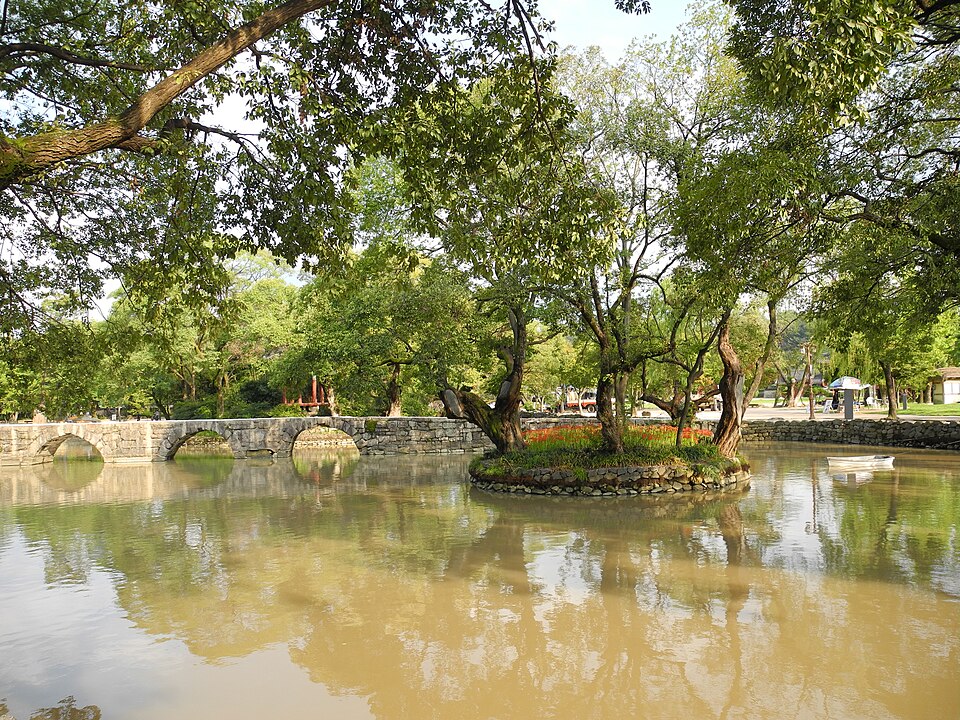
Gwanghalluwon Garden in Namwon, photographed on 18 September 2012. Photo: Namwon030, “Gwanghallu Garden (Namwon).JPG”, CC BY-SA 3.0, via Wikimedia Commons. Resized for display.

At Gwanghalluwon in Namwon, a pond is more than a setting for a pavilion. Water, islands and a bridge give physical form to imagined worlds, while the story of Chunhyang supplies another way of moving through the garden. Begin with what the arrangement lets you see, then let the interpretation complicate the view. You can enjoy the place before mastering all its references.
A pavilion, and the world around it
Gwanghallu is the pavilion; Gwanghalluwon is the wider garden. The Korea Heritage Foundation's introduction explains the moon-palace associations of the pavilion's name, the pond's connection to the Milky Way and the islands' representation of legendary mountains. This is a designed landscape with a symbolic life, rather than a collection of ornaments.
Begin on a public path where you can take in a building and its surroundings together. Notice what the water separates and what a bridge brings within reach. You might first see a roof as the main subject, then find that the space around it is doing just as much work.
Try a second viewpoint before taking your preferred photograph. An island that looked central may move to the edge of the composition. A pavilion may become a frame rather than an object. These small changes are a useful way to experience a garden without hurrying to the next named feature.
Cross into the stories
Ojakgyo belongs to the garden's network of literary and mythical associations. Heritage interpretation connects the bridge with the separated lovers Gyeonwoo and Jiknyeo. Read that explanation as a cultural story, then consider how crossing water gives the idea a physical form.
Gwanghalluwon is also associated with the meeting of Chunhyang and Mong-ryong in the well-known Korean love story. The KTO listing identifies related features including Chunhyang Hall, the shrine and Wolmae House. These are places of interpretation and remembrance; they do not turn fictional events into documented meetings.
You do not need to follow every narrative thread. Choose one display that interests you and read it fully. If the names are unfamiliar, save them alongside a brief note about what they mean. This is more useful than collecting photographs of plaques you will never read again.
Give the garden a quieter pass
After the most recognizable views, return to an ordinary stretch of path. Look for the relationship between a tree, a roof edge and the water. Consider how your attention differs when a feature has no obvious connection to a famous scene.
Keep crossings clear for other visitors, and use the designated routes around the pond. A convincing photograph does not require stepping into planting or waiting in the middle of a bridge. Let people pass, then decide whether the view still needs a photograph at all.
Think of the visit as two passes: first the arrangement of the garden, then one story within it. That structure leaves room for personal interest without making a complete inventory your measure of success.
Plan for the place you want to see
Save 광한루원 and the address, 1447 Yocheon-ro, Namwon. The city's visitor page provides seasonal opening and admission information. Check those details for your date; a garden visit does not automatically include a performance, special event or access to every interior.
Continue the theme through our Gungnamji pond feature, or compare the scale of this historic garden with the landscapes at Suncheon Bay National Garden. They are separate destinations, not additions to a walking route around Namwon.
Primary sources checked 7 November 2026: Korea Heritage Foundation, KTO and Namwon City visitor guidance. The suggested looking sequence is original editorial advice.
'Visitor Guides' 카테고리의 다른 글
| Seongeup Folk Village, Jeju: Stone Walls Around Everyday Life (0) | 2026.11.07 |
|---|---|
| Abai Village, Sokcho: The Waterway and the Lives Beside It (0) | 2026.11.07 |
| Ganghwa Dolmen: The Space Around an Ancient Stone (0) | 2026.11.07 |
| Naesosa, Buan: From Fir Trees to Flowers Carved in Wood (0) | 2026.11.07 |
| Buseoksa, Yeongju: A Temple Revealed by the Climb (0) | 2026.11.07 |