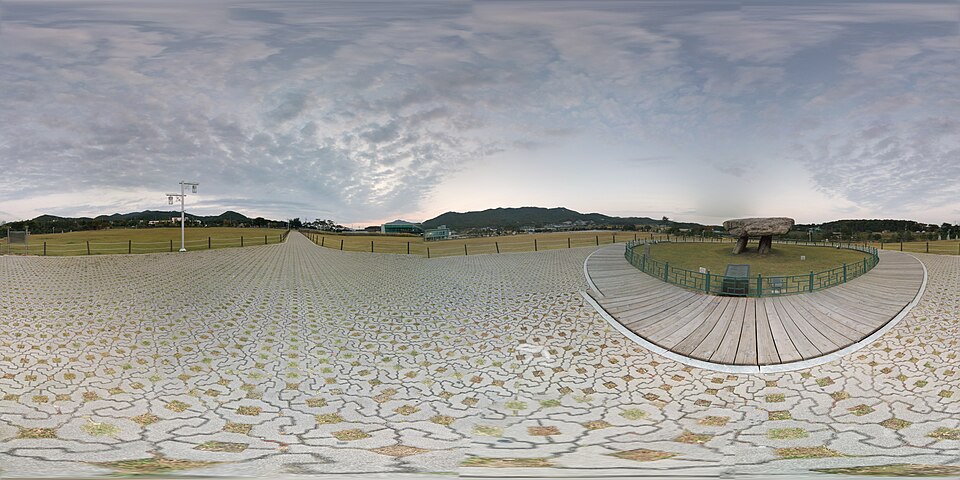
Panoramic view of the Bugeun-ri dolmen site on Ganghwa Island, photographed on 13 October 2014. Photo: Cuhullin, “20141013강화역사박물관고인돌.jpg”, CC BY-SA 4.0, via Wikimedia Commons. Resized for display.

A dolmen is easy to recognize in silhouette: a large stone held above the ground. At Ganghwa's Bugeun-ri site, resist letting that outline become the whole visit. The more absorbing questions concern the work behind it, the burial traditions it represents and the landscape in which it stands. Give the surrounding space as much attention as the famous profile.
A monument made through work
UNESCO's account of the Gochang, Hwasun and Ganghwa Dolmen Sites identifies these structures as prehistoric funerary monuments built from large stone slabs. It emphasizes what they can reveal about communities, beliefs and the techniques of moving and raising stone. Ganghwa belongs to a wider group of sites, not a single isolated object.
Start with the interpretation at the site. Identify the capstone and the supporting elements in the monument before you, then look at their relationship to the ground. You can consider weight and balance without inventing a precise account of how this particular stone was lifted.
That distinction matters. A striking shape invites explanations, but an archaeological question is not answered by a confident guess. Let the labels establish what is known, and keep your own imagining clearly separate. A question left open can make a better memory than an unsupported story.
Let the landscape enter the frame
The Korea Heritage Service's introduction places Ganghwa's dolmens in a prehistoric landscape around Goryeosan. UNESCO describes the Ganghwa component as distributed across mountain slopes. A visit to Bugeun-ri is therefore an encounter with one part of a much larger landscape of monuments.
Use the designated viewing area to change your angle. Take one view that gives the stone its familiar prominence, then another that includes more of the ground and horizon. Compare the questions each picture encourages. One may emphasize an extraordinary object; the other can help you think about where people chose to place it.
Keep to the public route and respect every barrier. Do not climb the monument, touch its surfaces to demonstrate scale or move closer across protected ground. The point of a wider view is to understand the setting, not to turn the stone into outdoor furniture.
Burial without an invented biography
A funerary monument connects a landscape to the way a community treated its dead. It does not necessarily supply the name, voice or life story of the person commemorated. Allow that absence to remain part of the visit.
You might consider two different kinds of effort: the physical labor needed to make a monument and the continuing work required to care for it. That comparison brings the distant past into a present responsibility without pretending that the past is fully recoverable.
If there is a group visiting ahead of you, wait at a suitable distance and read before approaching. An unhurried look after the group moves can be more useful than squeezing into the same photograph. The visit needs a little attention, not a particular amount of time.
Keep the plan focused
Save 강화 부근리 지석묘 for your map search and confirm that it points to the Bugeun-ri monument. A broad search for Ganghwa dolmens can lead to different locations. The Korea Tourism Organization's visitor guide provides site information; check current guidance before planning a larger circuit or relying on facilities being open.
Our Gyeongju royal-mounds feature offers another encounter with a burial landscape from a different period. The Haemieupseong story considers the named labor recorded in a later stone structure.
Primary sources checked 7 November 2026: UNESCO, the Korea Heritage Service and the Korea Tourism Organization. Viewing prompts are original editorial suggestions.
'Visitor Guides' 카테고리의 다른 글
| Abai Village, Sokcho: The Waterway and the Lives Beside It (0) | 2026.11.07 |
|---|---|
| Gwanghalluwon, Namwon: A Garden With More Than One Story (0) | 2026.11.07 |
| Naesosa, Buan: From Fir Trees to Flowers Carved in Wood (0) | 2026.11.07 |
| Buseoksa, Yeongju: A Temple Revealed by the Climb (0) | 2026.11.07 |
| Dumulmeori, Yangpyeong: The Two Rivers Behind the View (0) | 2026.10.29 |