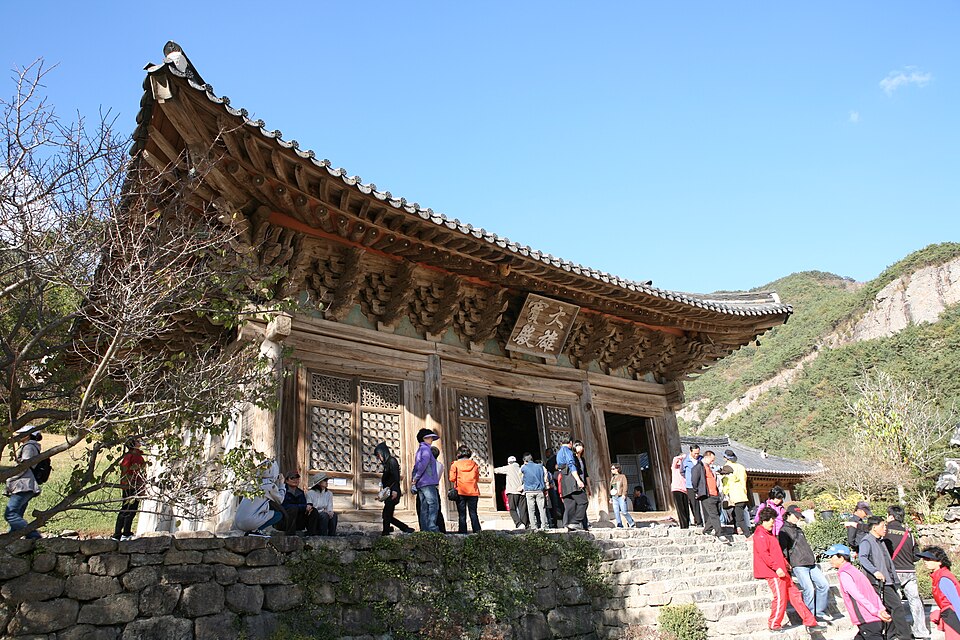
Daeungbojeon Hall at Naesosa in Buan, photographed on 1 November 2008. Photo: Byungjoon Kim, “Korea-Buan County-Naesosa-Daungbojeon-01.jpg”, CC BY 2.0, via Wikimedia Commons. Resized for display.

Naesosa offers a satisfying change of scale: tall fir trees on the approach, then flowers small enough to be carved into a wooden door. Build a visit around that transition. The pleasure is not only in reaching the main hall, but in noticing how your attention moves from an avenue of trees to the detail of a building.
Let the approach do its work
The Korea Tourism Organization's introduction identifies the fir-lined path into Naesosa. Buan County describes the stretch between Iljumun and Cheonwangmun as part of the temple approach. Treat it as an introduction to the visit, with time to settle into walking before looking for the next attraction.
On the public path, look up briefly, then return your eyes to the ground ahead. Compare the vertical rhythm of the trunks with the direction you are moving. If you want a photograph, step to a suitable place without blocking the route or entering the area around the roots.
Try putting your phone away for part of the approach. You may notice a change in light, a gap between trees or simply the difference between walking toward something and hurrying to reach it. None of those observations needs to become a claim about how everyone should feel in a forest.
Find a flower in the building
Naesosa's Daeungbojeon is the main hall. Buan's official interpretation draws attention to its floral wooden lattice, including lotus and chrysanthemum designs, and to the visible material of the doors. This gives you a specific detail to seek after the larger rhythm of the trees.
Choose one repeated shape and follow it across a section of the door from the permitted viewing area. Look at the spaces between the carved elements as well as the flowers themselves. A pattern can appear dense at first and become legible when you give it a smaller field of attention.
Leave the wood untouched. You do not need to feel a carving to appreciate its depth, and a close photograph should not involve leaning against a door or interrupting someone using the hall. Read the entry and photography signs before deciding how close to go.
A courtyard still in use
The hall is part of a Buddhist temple, so keep worship and ordinary temple activity in view as you move around the courtyard. If entry is permitted, follow the instructions at the doorway and give people who are praying room. If it is not, the exterior offers plenty to consider.
There is also a painted story beyond the carved surface. A 2026 Korea Heritage Service announcement concerned the recording of Daeungbojeon's interior decorative painting. Use that as a prompt to read the on-site interpretation for the hall's decoration, rather than assuming the doors are its only artistic feature.
Before returning through the trees, look at the relationship between the building and the open ground around it. The courtyard allows a different distance from the architecture. What seemed like an isolated detail at the door can become part of a larger arrangement of roof, opening and space.
Keep the outing manageable
Save 내소사, Buan, and confirm the arrival point on your map. KTO identifies its listed address as the ticket-booth location, so distinguish that from the hall itself when planning your approach. Check current visitor information and your return journey before setting out. Choose footwear and a pace suited to the conditions on the day.
Our Dongguksa feature considers a different temple's architectural history. For another way of looking at wood and rooflines, continue with our Jeonju Hanok Village story.
Primary sources checked 29 October 2026: KTO, Buan County and Korea Heritage Service's August 2026 announcement. Suggested viewing exercises are original editorial advice.
'Visitor Guides' 카테고리의 다른 글
| Gwanghalluwon, Namwon: A Garden With More Than One Story (0) | 2026.11.07 |
|---|---|
| Ganghwa Dolmen: The Space Around an Ancient Stone (0) | 2026.11.07 |
| Buseoksa, Yeongju: A Temple Revealed by the Climb (0) | 2026.11.07 |
| Dumulmeori, Yangpyeong: The Two Rivers Behind the View (0) | 2026.10.29 |
| Jinjuseong, Jinju: Stone Walls, War Records and the Namgang (0) | 2026.10.29 |