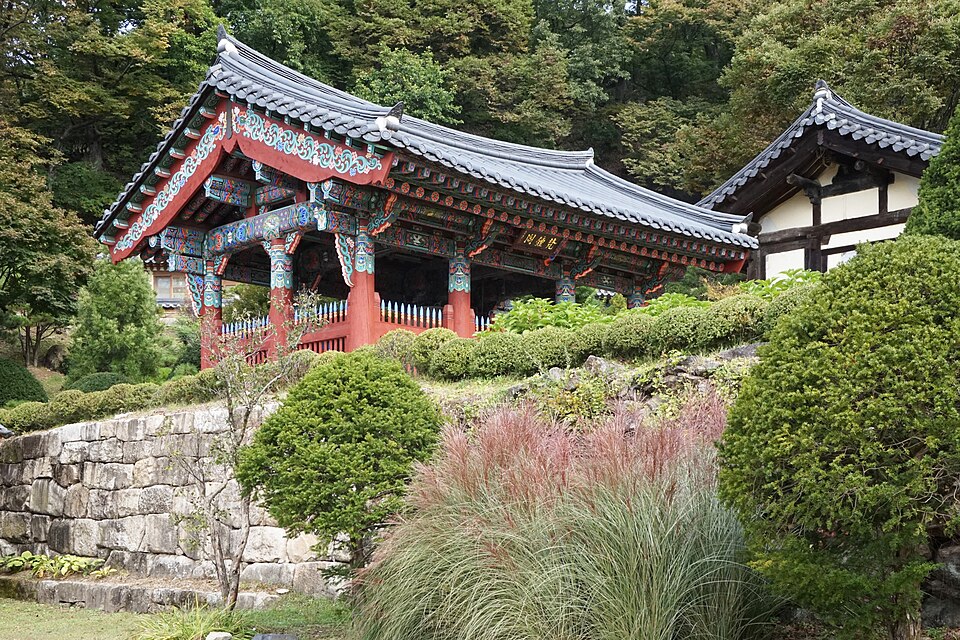
Buseoksa Temple in Yeongju, photographed on 9 October 2022. Photo: Bernard Gagnon, “Buseoksa Temple 03.jpg”, CC0 1.0, via Wikimedia Commons. Resized for display.

At Buseoksa in Yeongju, the approach belongs to the architecture. Gates, changes of level and partial views make the temple a sequence rather than a single building waiting at the end of a path. Plan to notice what appears and disappears as you go, with enough room in the day to let your own pace set the visit.
A route that does not reveal everything at once
The National Institute of Korean History's architectural introduction follows the approach through gates and stone steps toward the pavilions and Muryangsujeon. It describes building axes adjusted to the terrain, creating views in which the hall is only gradually revealed. That is a useful lens for looking, without turning your walk into a lesson to memorize.
At a suitable resting place off the flow of visitors, look back at the level you have just left. Then face forward and notice how much of the next building is visible. The difference between those views is part of the design you are experiencing.
Keep photographs for places where you can stand securely. Stopping in the middle of a stairway can make the approach awkward for everyone else. If the climb needs more time or pauses than you expected, adjust the plan. Reaching every corner is less useful than being able to look comfortably at the parts you do visit.
Arriving at Muryangsujeon
Yeongju City's introduction identifies Muryangsujeon among Korea's oldest surviving wooden buildings. Its age is a reason to look carefully at the structure, rather than a competition to decide which heritage site is oldest.
Study the hall from the permitted visitor area before moving closer. Compare the line of the roof with the vertical supports. The history institute points to the columns' slight outward curve, often described as entasis. You can look for that change in profile without touching or leaning against the timber.
Give the space in front of the hall a separate look. Consider the relationship between the architecture, the stone lantern and the wider view. The climb has changed your position in the landscape; take a moment to register that shift before making another image.
A monastery beyond its famous hall
Buseoksa forms part of the UNESCO property Sansa, Buddhist Mountain Monasteries in Korea. UNESCO's account emphasizes continuing religious practice and monastic daily life alongside the buildings. This is a place where heritage and present use share the same ground.
Read access signs before entering a hall or following a side route. Keep away from residential and restricted areas, and make space for worshippers. If you encounter a service, quiet observation from an appropriate position may be more suitable than carrying on with a planned photography sequence.
Consider the architecture as a set of relationships rather than a catalogue of treasures. An approach prepares an arrival, a courtyard makes room around a hall, and a view connects a building to its surroundings. You can leave with an understanding of one relationship even if the rest remains unfamiliar.
Make a plan that includes the return
Save 부석사 and confirm Yeongju as the destination; use the city's address, 345 Buseoksa-ro, Buseok-myeon. Check current temple notices, access needs and the actual return connection for your travel date. A mountain setting and stepped approach deserve planning that accounts for your mobility and the day's weather.
Our Hahoe Village feature offers another way to read architecture within a landscape. The Dongguksa story considers a temple with a different architectural and historical setting. Plan each as its own destination.
Primary sources checked 29 October 2026: National Institute of Korean History, Yeongju City and UNESCO. Viewing sequence and pacing suggestions are original editorial advice.
'Visitor Guides' 카테고리의 다른 글
| Ganghwa Dolmen: The Space Around an Ancient Stone (0) | 2026.11.07 |
|---|---|
| Naesosa, Buan: From Fir Trees to Flowers Carved in Wood (0) | 2026.11.07 |
| Dumulmeori, Yangpyeong: The Two Rivers Behind the View (0) | 2026.10.29 |
| Jinjuseong, Jinju: Stone Walls, War Records and the Namgang (0) | 2026.10.29 |
| Mireuksa Temple Site, Iksan: The Temple in Its Surviving Pieces (0) | 2026.10.29 |