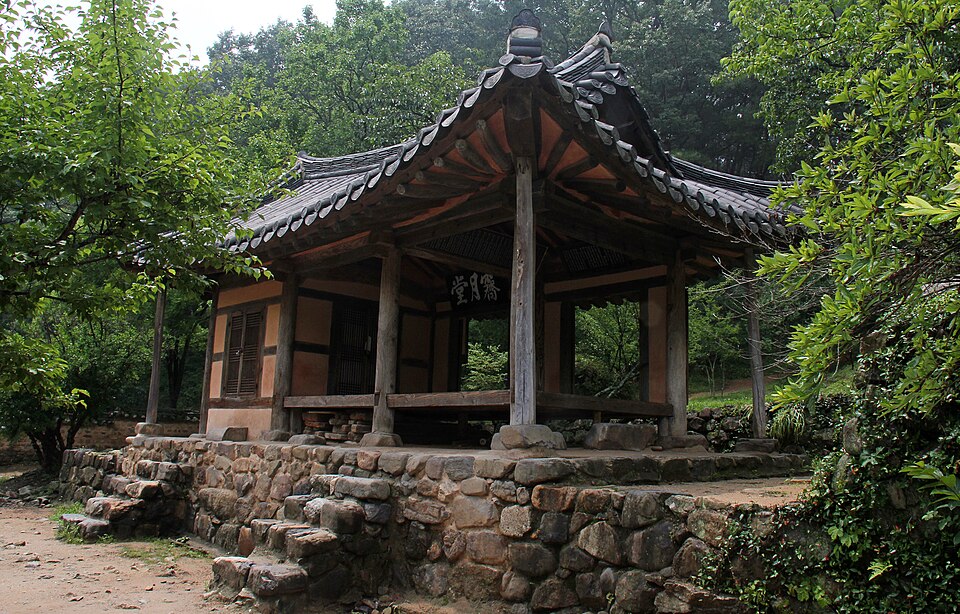
Soswaewon Garden in Damyang, photographed in July 2012. Photo: Korea.net / Korean Culture and Information Service (Jeon Han), “KOCIS Korea Soswaewon 01 (7581350982).jpg”, CC BY-SA 2.0, via Wikimedia Commons. Resized for display.

Soswaewon’s stream passes through its boundaries and gives its pavilions a setting. In Damyang, this Joseon garden offers a compact encounter with landscape design: water, walls and buildings arranged for reading, receiving visitors and withdrawing from public life.
The garden’s story begins with a difficult departure. Yang San-bo created Soswaewon after his teacher, the reformer Jo Gwang-jo, died following a political purge. The Korea Tourism Organization presents it as a retreat from an official career into a landscape of his own. That history gives the place more substance than a general promise of a peaceful afternoon.
For a visitor, its small scale is an advantage. You can give attention to the relationship between a wall, a stream and a pavilion without needing to cross a large estate. The garden rewards time spent understanding those connections.
Water through a boundary
A bamboo-lined approach leads toward the garden. KTO describes trees and other planting on both banks of the stream, with water running at the foot of the walls. These edges are part of the design: the watercourse is accommodated within a composed landscape.
The more detailed KTO garden account explains how openings allow valley water to pass through the boundary and continue over rocks near Gwangpunggak. A wall can separate spaces while allowing a stream to maintain its course. It is a small architectural decision with a large effect on how the place is understood.
Follow that relationship from the public paths. Notice where a built edge meets the water and where a building is placed beside it. The interest is in the arrangement, so the visit can work without a particular season of flowers or an ideal photographic sky.
Here, the boundary is part of the water’s route.
Keep to the visitor route around the stream and stonework. Steps, edges and changes in level deserve your attention as you move; choose a pace that lets you stop comfortably without blocking the path for others.
A place to read, a place for guests
Two names give the buildings distinct roles. Jewoldang occupies higher ground and is associated with Yang San-bo’s reading. Gwangpunggak, beside the valley, served to receive guests. KTO translates the “Jewol” in Jewoldang as the clear moon after rain, adding a literary association to the house’s position.
These uses make the retreat socially interesting. It had space for study and space for company. A garden made in response to disappointment in public life could still accommodate conversation. The buildings let that idea take physical form, with different positions and purposes within the same enclosure.
Consider them from the areas open to visitors, and enter a pavilion only where current instructions permit. Their relationship can be appreciated from the path; a raised floor should not be assumed to be an unrestricted resting place.
The Korea Tourism Organization notes that only part of the earlier ensemble of buildings survives. The garden therefore has a history of change as well as continuity. Let the on-site interpretation identify the individual structures rather than assigning every surface and planting a single unaltered age.
Keep the rest of the day proportionate to this visit. Leave space for a meal and your onward journey, and check any second destination independently. Soswaewon is a complete subject for an outing rather than an item that has to be combined with a particular bamboo park or café.
The Yangnim-dong architecture feature explores another set of homes and public uses in the region. For a different relationship between cultivation and landscape, read our Boseong tea-field story.
Visit note: Soswaewon is at 17 Soswaewon-gil, Gasamunhak-myeon, Damyang. Check the garden’s current visitor information for seasonal hours and admission before setting out. Allow time for the bamboo-lined approach as well as the garden itself.
Official sources checked 7 November 2026: KTO’s Soswaewon listing, KTO’s garden interpretation and KTO’s historical account.
'Visitor Guides' 카테고리의 다른 글
| Uirimji Reservoir, Jecheon: A Lake With Work to Do (0) | 2026.11.07 |
|---|---|
| Seongeup Folk Village, Jeju: Stone Walls Around Everyday Life (0) | 2026.11.07 |
| Abai Village, Sokcho: The Waterway and the Lives Beside It (0) | 2026.11.07 |
| Gwanghalluwon, Namwon: A Garden With More Than One Story (0) | 2026.11.07 |
| Ganghwa Dolmen: The Space Around an Ancient Stone (0) | 2026.11.07 |